Massimo Ragnedda

Part of the Stanford/Elsevier Top 2% Scientist Rankings 2025

Digital Engagement and Life Chances

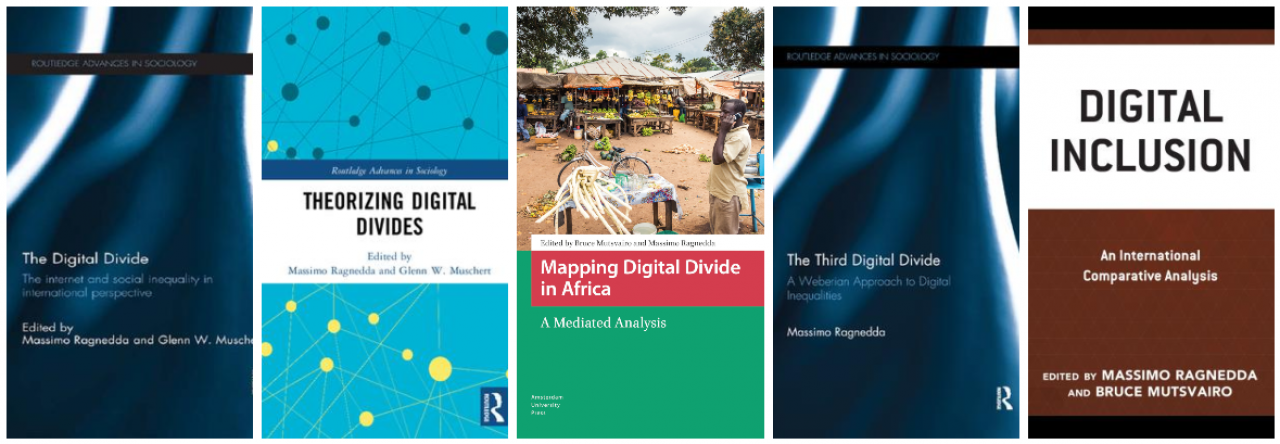
Digital Engagament and Life ChancesMassimo Ragnedda (2017), The third digital divide. A weberian approach to digital inequalities, Routledge. pp 80-82.

The individual and social characteristics of the subjects determine the resources available to them. In turn, resources affect access and act as the ground on which new digital inequalities can develop. The unequal distribution of resources produces unequal access to digital technologies and then produces the first form of exclusion (first level of digital divide). Inequality in access also depends on the characteristics of the technologies and different pathways of technological appropriation, which result in differences in skills, and, therefore, new forms of exclusion (second level of digital divide). The sum of the inequalities considered prevents full participation and social inclusion. The appropriation of technology tends to influence the level of social participation. The variables that illustrate the positioning of the individual in society may be ‘individual variables’ (age, gender, ethnic group) or ‘social variables’ (income, position in the labour market, status group). These variables influence how we access and use the resources which are at the base of the process of inclusion or exclusion from society. The phenomena of social inclusion and exclusion are increasingly part of the European political and discursive agenda.

The Third Digital Divide A Weberian Approach to Digital Inequalities

Introduction

This book uses the theoretical framework developed by Weber to analyse the phenomena of the digital divide and digital inequalities in relation to social stratification.

The aim of this book is thus to sketch a concept of stratification and inequalities in the digital sphere, in order to clarify whether the digital divide simply extends traditional forms of inequality, or whether it also includes new forms, which might include counter-trends that alleviate traditional inequalities and/or which form new modalities of inequality. As we shall see, inequalities that exist in the digital sphere are certainly entangled with inequalities present in the social sphere.

The discussion will proceed from a theoretical perspective using Max Weber’s theory of stratification, in order to clarify how social stratification in the digital age is reproduced online. The main idea is that inequalities in the digital sphere are based on features that, just as in the social sphere, go beyond the economic aspects of inequality. To understand digital inequalities, the discussion should not focus only on class dynamics (economic aspects), but also status/prestige (cultural aspects) and group affiliations (political aspects). As in “real life”, social stratification in the digital sphere is the result of this complex interplay of three factors. These key distinctions Weber identified about social inequality are still significant in a digital age.

Exclusão digital: como é estar do lado errado da divisão digital. (Digital exclusion: be on the wrong side of the digital divide)

cover_issue_9410_pt_brMassimo Ragnedda and Maria Laura Ruiu (2016), Exclusão digital: como é estar do lado errado da divisão digital (Digital exclusion: be on the wrong side of the digital divide), Revista Online de Comunicação, Linguagem e Mídias, 10(20): 90-113.

Abstract: The development of the information society has highlighted the existence of obstacles preventing
certain social groups from accessing and properly using technologies, leading to new forms of exclusion from the job market, governmental institutions, leisure and academic activities. However, reducing the gap between those who connect and those who do not by offering cheaper and faster physical access does not automatically translate into closing the gap in terms of digital inequalities. The technological determinist position, which sees access to technology as being able to solve social problems, including problems of social inequality, democracy, freedom, social relationships and sense of community, is misleading. In fact, several dimensions and patterns can generate and reinforce inequalities, further increasing the distances between citizens/users. The term “digital divide”, often used as a binary expression, is confusing, because it suggests a one- dimensional gap, mainly based on the economic factor – possession of technologies –, while there are gaps in multiple dimensions that go beyond the simple access to or possession of resources. These dimensions create digital inequalities that, if not mirrored, can produce and reinforce social inequalities. The concepts of social and digital stratification are intimately intertwined

Empowering local communities through collective grassroots actions: The case of “No Al Progetto Eleonora” in the Arborea District (OR, Sardinia)

Maria Lgcrvaura Ruiu & Massimo Ragnedda (2017) Empowering local communities
Abstract. This article explores both how local social committees may contribute toward generating collective actions, leading local communities to empower their environment, and how new information communication technologies (ICTs) may alter the collective action. It focuses on a case study, represented by the “No al Progetto Eleonora” local committee that operates in the Arborea district of Oristano, in Sardinia, Italy. Here, the community has become progressively cohesive in the face of an external environmental threat represented by the proposal for a drilling project. In this context, the role played by the Internet has been marginal in promoting community cohesion, even if it has indirectly enhanced it. In other words, the Internet played a marginal role in promoting the protest and reinforcing community cohesion, but it played a primary role in attracting external solidarity and support, thus indirectly reinforcing the sense of community against an external threat.

Between digital inclusion and social equality: the role of public libraries in Newcastle upon Tyne

library-and-information-researchMaria Laura Ruiu, Massimo Ragnedda, Between digital inclusion and social equality: the role of public libraries in Newcastle upon TyneLibrary and Information Research Volume 40 Number 123 2016

Abstract This paper is based on findings obtained from qualitative research on the role of the public library service in reducing digital inequalities in disadvantaged neighbourhoods in Newcastle upon Tyne. Semi-structured interviews with four libraries’ staff members, and direct observations during ordinary activities and events organised by libraries aimed to explore both the role played by public libraries in reducing digital inequalities and the current challenges that these actors face to promote digital and social equality. It identifies positive impacts produced by the public libraries through digital education and digital infrastructures on disadvantaged neighbourhoods, while also identifying some barriers experienced by public library authorities in providing such services.

The Third Digital Divide A Weberian Approach to Digital Inequalities

The word clouds of “The Third Digital Divide. A Weberian approach to Digital Inequalities”. WordItOut-word-cloud-1940708.png

The 6Cs (six capitals). The digital capital

ecreaECREA Conference, Prague, 9-12 November 2016.

Abstract: Based on an extensive literature review on the existing influences between capital(s) and digital access, this paper will highlight the reciprocal influences between five capitals and digital capital, proposing a new theoretical approach in analysing digital inequalities. Social (Bourdieu 1986; Coleman 1990; Putnam 1995), economic (Bourdieu 1986), personal (Becker 1996), political (Seyd and Whitely 1997), and cultural capitals (Bourdieu 1986) influence the rise of digital capital which, in turn, not only generate a digital divide between people who can and cannot access the Internet (first level of digital divide), but also inequalities in terms of benefits they can gain on-line (second level of digital divide). Moreover, these 6C tend to create the third level of digital divide, seen as the returning social benefits of using the Internet.

The third Digital Divide. A Weberian approach to digital inequalities

third-digital-divide Coming soon. The third Digital Divide. A Weberian approach to digital inequalities, Routledge, 2017

Drawing on the thought of Max Weber, in particular his theory of stratification, this book engages with the question of whether the digital divide simply extends traditional forms of inequality, or whether it also includes new forms of social exclusion, or perhaps manifests counter-trends that alleviate traditional inequalities whilst constituting new modalities of inequality. With attention to the manner in which social stratification in the digital age is reproduced and transformed online, the author develops an account of stratification as it exists in the digital sphere, advancing the position that, just as in the social sphere, inequalities in the online world go beyond the economic elements of inequality. As such, study of the digital divide should focus not simply on class dynamics or economic matters, but cultural aspects – such as status or prestige – and political aspects – such as group affiliations.

Demystifying Digital Divide and Digital Leisure.

leisureMassimo Ragnedda and Bruce Mutsvairo (2016), Demystifying Digital Divide and Digital Leisure. Chapter in David McGillivray, Gayle McPherson, Sandro Carnicelli (eds) Digital Leisure Cultures: Critical Perspectives, Routledge, pp. 107-119.

Abstract: This chapter investigates the contribution of the digital divide towards the consumption of leisure among users. In analysing the entertainment and leisure dimensions of the Internet, the chapter draws on the literature exploring digital divide, but also on concepts such as network theory and liquidity. With the experience of leisure consumption in a postmodern society increasingly important as a distinctive form of identity, we question the extent to which digital inequalities, based on skills, income and education, influence leisure consumption online.

Demystifying Digital Divide and Digital Leisure

From Social to Digital Inequalities

13435300_10208296440186711_365484049517279225_nFrom Social to Digital Inequalities, paper presented at Intercom Comunicação, San Paulo, Brazil (18 June 2016).

Digital communication plays a key role in the process of the structuring of contemporary society, and may result in the emergence of new forms of social exclusion linked to digital inequalities. The digital divide is a form of social and digital exclusion which depends not only on technological, demographic and geographical factors, but also on economic, cultural and social circumstances associated with social structure. All these factors influence not only the use of the Internet, but also its cultural evolution and structure. The digital divide is a “moving target” that changes over time due to the diffusion of technological innovation; it therefore needs to be constantly redefined using more appropriate operational indicators. The Internet is a space that provides power for the growth of knowledge as a common good. The network structure is independent of the borders of the various states and has the potential to connect all the inhabitants of the earth, reducing disparities of all kinds. However, despite these unique qualities, many obstacles prevent their full integration. Diversified and unequal access to the Internet can create new forms of social segregation, which in turn generate communities based on weak ties (Ancu and Cozna, 2009; Baumgartner and Morris, 2010; Kraut et al., 1998; Withe, 2010, 2010; Gladwell, 2010; Fenton and Barassi, 2011). Inclusion and exclusion from the network society are based on the capabilities of technological devices (hardware and software), length and amount of Internet use, resources (mostly intangible) conveyed by the networks, digital skills, and online activities (DiMaggio et al., 2004; Hargittai and Hinnant, 2008; Howard et al., 2001; Van Dijk and Van Deursen, 2014). Van Dijk (2005: 166-177) identifies participation and social inclusion as the most important factors in combatting digital inequalities. In a network society where the new media are acquiring an increasingly important role in the acquisition of benefits and the competition between individuals, conventional electronic media and other traditional forms of communication will become less and less sufficient to allow full participation in each of these areas, while the use of the Internet will become ever more vital.

Pagina 10 di 34

Powered by WordPress & Tema di Anders Norén