Massimo Ragnedda

Part of the Stanford/Elsevier Top 2% Scientist Rankings 2025

My candidacy for the role of Vice Chair of the IAMCR Digital Divides Working Group

did-logo-optimalThe IAMCR Digital Divide Working Group will run partial elections for a co-vice chair position during its business meeting during the IAMCR2018 in Oregon.

The current chair Olga Smirnova and co-vice chair Anna Gladkova will stay in their positions having been elected in 2016 at the Leicester conference.

I have been serving as co-vice chair on an interim basis since IAMCR2017 conference and I am now seeking to formalise that position.

Call for Chapters. Blockchain and Web 3.0: Social, economic, and technological challenges

what-is-the-blockchainCall for Chapters.
Blockchain and Web 3.0: Social, economic, and technological challenges
Editors have been working with Emily Briggs (Commissioning Editor for Sociology, Routledge) to prepare this proposal.

Editors:
Massimo Ragnedda, Northumbria University at Newcastle.

Giuseppe Destefanis, School of Computer Science, University of Hertfordshire.

Deadline for abstracts: 10 April 2018

Notification of acceptance: 20 April 2018

Submission Date: 20 September 2018
Blockchain is no longer just about bitcoin or cryptocurrencies in general, but it can be seen as a disruptive and revolutionary technology, which will have major impacts on multiple aspects of our lives. The revolutionary power of such technology can be compared with the revolution sparked by the world wide web and the Internet in general. As the Internet can be seen as a mean for sharing information, so blockchain technologies can be seen as a way to introduce the next level: blockchain allows the possibility of sharing value. This book seeks to underline the risks and opportunities offered by the advent of blockchain technologies and the rise of the web 3.0. Given the nature, the implications and consequences of this new technology, this book will proceed from an interdisciplinary perspective. The core analysis in the book is explaining how such technologies are disruptive and, further, to explain the concrete consequences of these disruptions, in terms of social, economic and technological consequences. We anticipate that the comparative examination of these features will be helpful to clarify the dynamics and consequences of the blockchain technologies in a variety of disciplines settings. Thus, the volume integrates a number of chapters examining disparate settings around the world, all unified around their focus on the phenomenon of blockchain in comparative and interdisciplinary perspective.

Emerging political narratives on Malawian digital spaces

CommunicatioBruce Mutsvairo and Massimo Ragnedda (2017) Emerging political narratives on Malawian digital spaces, Communicatio, South African Journal for Communication Theory and Research, Volume 43, Issue 2, page 147-167.

Social media platforms are being considered new podiums for political transformation as political dictatorships supposedly convert to overnight democracies, and many more people are not only able to gain access to information, but also gather and disseminate news from their own perspective. When looking at the situation in several sub-Saharan African countries, it becomes clear there are various challenges restricting social media and its palpable yet considerably constrained ability to influence political and social changes. Access to the internet, or lack thereof, is a recognised social stratification causing a “digital divide” thanks to existing inequalities within African and several other societies throughout the world. This article reports on a study that analysed a popular Facebook page in Malawi using a discursive online ethnographic examination of interactions among social media participants seeking to determine the level of activism and democratic participation taking shape on the Malawian digital space. The study also examined potential bottlenecks restraining effective digital participation in Malawi. The article argues that while social media’s potential to transform societies is palpable, keeping up with the pace of transformation is no easy task for both digital and non-digital citizens. The study demonstrated social media’s potential but also highlighted the problems facing online activists in Malawi, including chief among them digital illiteracy. Therefore, the digital sphere is not a political podium for everyone in Malawi as shown by the analysis of digital narratives emerging from the country’s online environment, which opens its doors to only a tiny fraction of the population.

Digital Divide Working Group – CFP 2018

did-logo-vertical-optimalThe IAMCR’s Digital Divide Working Group invites submissions for its open sessions at the IAMCR 2018 Conference to be held from 20-24 June, 2018 in Eugene, Oregon, USA. The deadline to submit abstracts is 23:59 GMT on 31 January 2018. Proposals for consideration by IAMCR’s Digital Divide Working Group must be submitted via the Open Conference System at https://iamcr-ocs.org

The overarching conference theme in 2018 is Reimagining Sustainability: Communication and Media Research in a Changing World. The theme is centered around the notion of sustainability, which is defined by the United Nations as harmonizing three core elements, environmental protection, social inclusion, and economic growth, so as to meet the needs of the present without compromising the ability of future generations to meet their own needs. The theme seeks to explore how sustainability is affected by the environment, as well as by human activities (social, economic and political ones) and current lifestyles. It also attempts to stimulate a discussion about the ways media can contribute to sustainable development in the societies, both by drawing public attention to the problem of sustainability and by promoting the values of social inclusion, openness and transparency in the modern world.

Social capital and the three levels of digital divide.

Social capital and digital divideMassimo Ragnedda and Maria Laura Ruiu (2017) Social capital and the three levels of digital divideIn Ragnedda M., Muschert G. eds. (2017), Theorizing Digital Divides, Routledge.

Introduction. Although the relation between the Internet and social capital has been largely investigated (Wellman, 2001; Vergeer and Pelzer, 2009; Hampton, Sessions, and Her, 2011), the nature of such relation is still unclear. The ongoing dispute is still between two opposite positions emphasized in the really early stage of Internet studies (Wellman, 2001): on the one hand, the Internet increases and improves social relationships (Lévy, 1997); on the other, it negatively affects face-to-face relationships (Stoll, 1995). A number of studies have implicitly investigated that relation by emphasizing the role of the Internet in promoting both new democratic, participatory and open spaces (Sproull and Kiesler, 1991; Kapor, 1993), and collective action (Frantzich, 1999; Diani, 2000). This enthusiastic attitude, which we can define as a “techno-evangelist” approach, sees the Internet as a place of freedom in which people (with similar and different perspectives) meet up for “building” something together. According to this approach, the virtual space gives to users a “power capital”, represented by freedom of choices and democratic spaces of discussion. In these virtual spaces, citizens have the power to decide and mobilize people and resources towards a common objective. By contrast, a “techno-skeptic” approach sees the other side of the coin, in which Internet users increase their activity online while decreasing and weakening their social interactions and civil participation offline (Kraut et al., 1998; Gladwell, 2010; Fenton and Barassi, 2011). More specifically, earlier studies show how online activities may also enhance and increase social, human and economic capital (Hargittai and Hinnant, 2008; Hassani, 2006). These are part of a broader body of research that has focused on how social capital may affect digital divide (Chen, 2013; DiMaggio and Cohen, 2003). Literature on this relationship mainly refers to how the digital divide may increase the inequalities in terms of possession of social capital (Pénard and Poussing, 2014; Di Maggio et al., 2004; Katz and Rice, 2003). More specifically, Kvasny (2006), Robinson (2009) and Sims (2014) adapted Bourdieu’s theory to the Internet and new media research.

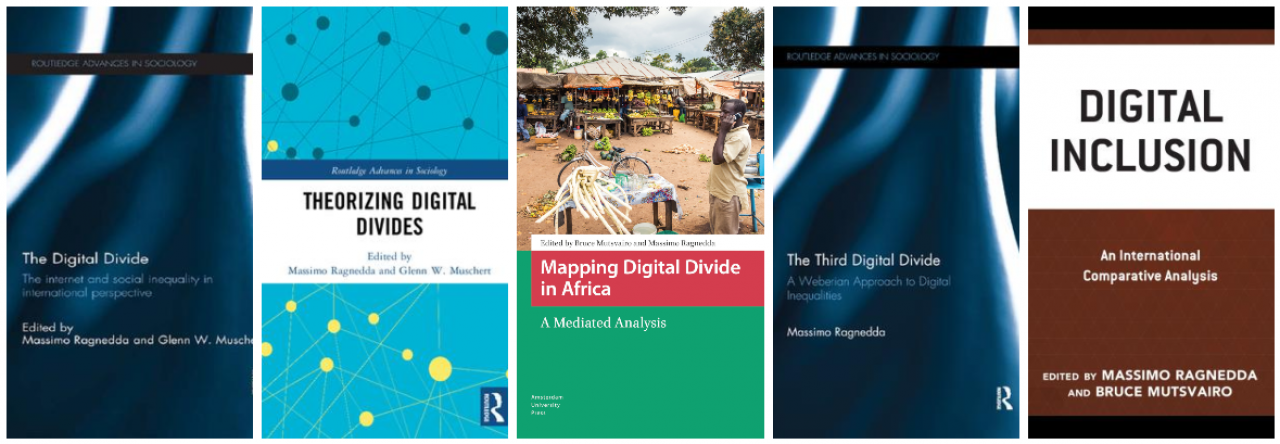
Theorizing Digital Divides

theorizing digital dividesMassimo Ragnedda and Glenn W. Muschert, Theorizing Digital Divides, Routledge, 2017

Google preview

Description

 This volume examines and explains the phenomenon of digital divides and digital inequalities from a theoretical perspective. Indeed, with there being a limited amount of theoretical research on the digital divide so far, Theorizing Digital Divides seeks to collect and analyse different perspectives and theoretical approaches in analysing digital inequalities, and thus propose a nuanced approach to study the digital divide.

Exploring theories from diverse perspectives within the social sciences whilst presenting clear examples of how each theory is applied in digital divide research, this book will appeal to scholars and undergraduate and postgraduate students interested in sociology of inequality, digital culture, Internet studies, mass communication, social theory, sociology, and media studies.

Endorsements

Prof. Steve Jones (UIC Distinguished Professor of Communication at the University of Illinois at Chicago): This book provides a much-needed wide-ranging theoretical foundation for research on the digital divide. While scholars and activists have done yeoman’s work identifying, studying and narrowing digital divides, Ragnedda and Muschert have put together the theoretical infrastructure with which we may understand past efforts and move forward with new ones.

Prof. Bridgette Wessels (Newcastle University): This is a welcome volume that develops our understanding of digital divides. It does so through a highly informed understanding of current theoretical knowledge of digital divides in a range of disciplinary perspectives.  The authors combine to extend this knowledge in meaningful ways to address the nuances and complexities of digital divides.  The theoretical developments will be extremely beneficial for scholars and students working in the area of digital divides.


The rise of the Digital capital and its relation with the third level of Digital Divide (IAMCR 2017)

Digtal capitalAt the International Association of Media and Communication Research annual conference in Cartagena (16-20 July) I introduced the concept of Digital Capital and I explained its relationship with the third level of Digital Divide. Great positive response and feedback from audience. Next step is how to operationalize the digital capital.

Here the abstract of my presentation. This paper makes a theoretical contribution by looking at the rise of the digital capital and how its relation with previous Five Capitals (social, economic, personal, political and cultural capitals) generates both inequalities in online experience (second level of digital divide), and it creates the third level of digital divide, seen as the returning social benefits of using the Internet (Ragnedda 2017). The digital capital is a bridge capital which influence the ways people look for information, their motivation, support, and provide the skills to elaborate, process and use such information to improve their life chances. The opportunities given by the use of ICTs are not the same for everybody, but are the product of the interaction between the 5Cs and the digital capital. To make profitable the benefits gained on the digital realm and invest them into the social realm, users/citizens need a solid and strong social (Bourdieu, 1986; Coleman, 1990; Putnam, 1995), political (Seyd and Whitely, 1997), economic (Bourdieu, 1986), personal (Becker, 1996) and cultural capitals (Bourdieu, 1986) on which to rely on. These 5Cs help citizens to turn the digital benefits into social benefits and to exploit the full advantages offered by the Internet (third level of digital divide). The paper will look at the process through which income (economic capital) education (cultural capital), family and occupation (social and personal capital), motivation and purpose of use (personal capital), and political engagement (social and political capital) determine the rise of the digital capital and how, in turn, this new capital affects the digital divide at its three levels: access-use-benefits. Although, the digital capital is not a new concept, it has been used mainly in relation to the resources on which the development of new services and products for the digital economy rely (see e.g. Tapscott et al., 2000; Roberts and Townsend, 2015). What is missing in the literature is both a theoretical discussion on the digital capital, and how it could affect the second and third level of digital divide.

IAMCR 2017 preconference: Mapping New Perspectives and Debates on Digital Divide in Africa

PreconferenceWith my colleague Bruce Mutsvairo (University of Technology Sydney) we have organized a preconference at the IAMCR 2017, Cartagena (Colombia). Part of the outcome will be published in a book we are editing for Amsterdam University Press (2018). 

Here the call. Social media platforms are being considered new podiums for political transformation as political dictatorships supposedly convert to overnight democracies as more and more people are not only able to gain access to information but also gather and disseminate news from a perspective of their own. When looking at the situation in several sub-Saharan African countries, it becomes clear there are several challenges standing in the way of social media and its palpable yet considerably constrained ability to influence political and social changes. Access to the Internet or lack of it there of, is a recognized social stratification causing “digital divide” thanks to existing inequalities within African and several other societies throughout the world. Despite issues associated with the digital divide, mobile telephony is growing on the continent and the rise of smartphones has given citizens easy access to social networking sites. But the digital divide, which mostly reflects on one’s race, gender, socioeconomic status or geographical location, stands in the way of digital progress.

The Quadruple Helix Model of Libraries: The Role of Public Libraries in Newcastle upon Tyne

wplq20.v036.i01.coverMaria Laura Ruiu & Massimo Ragnedda (2017): The Quadruple Helix Model of Libraries: The Role of Public Libraries in Newcastle upon Tyne, Public Library Quarterly, DOI: 10.1080/01616846.2017.1318642

Abstract

This article is based on semistructured interviews with library staff members in order to explore both how they perceive the role of libraries in most deprived areas in Newcastle upon Tyne and how they relate with their patrons. We show that public libraries play a primary role in activating a virtuous cycle, in which infrastructures, skills, and increased ability of users to achieve their goals simultaneously result from and feed social inclusion strategies. However, some limits might be related to the availability of public economic resources that tends to affect the smaller libraries by reducing opening times and services provided.

UK General Election 2015: dealing with austerity

Banner_issue_1Massimo Ragnedda and Maria Laura Ruiu (2017), UK General Election 2015: dealing with austerity SACS-o Working Papers, Newcastle University.

Abstract: This article investigates the nature of the conversation around austerity on Twitter during the 2015 general election in the UK. Specifically, it explores the kinds of messages referring to austerity, as well as the kinds of accounts involved (whether they referred to a private or public role on Twitter and in society) and their affiliation to politically or non-politically oriented organizations/bodies. The search on Twitter concerning the austerity topic (for the 39-day time period from 3 March to 8 May 2015) resulted in 16,015 tweets, which generally referred to austerity, and 11,146 tweets, which contained at least one relevant hashtag. While austerity was rarely mentioned by mainstream media accounts in the Twittersphere, this topic was widely discussed during the election campaign by private users. This could be seen as a limitation of agenda setting, since there is no correlation between the agenda set by the media on Twitter and the public discussion about it. However, we found a relationship between the offline mainstream media agenda and the discussion led by private users on Twitter, thus confirming, to some extent, the validity of intra-agenda setting. In fact, offline media events (talk shows, news articles and question times) seemed to trigger peaks in tweet-based discussions or mentions about austerity, showing that the agenda set by the offline media influenced the discussion in the Twittersphere. Finally, we found that, while austerity has clear implications for citizens’ daily life, it seems to be more of an “elitist” topic, mainly addressed by those who are already politically oriented and well informed on the topic.

Download the full article

Pagina 9 di 34

Powered by WordPress & Tema di Anders Norén