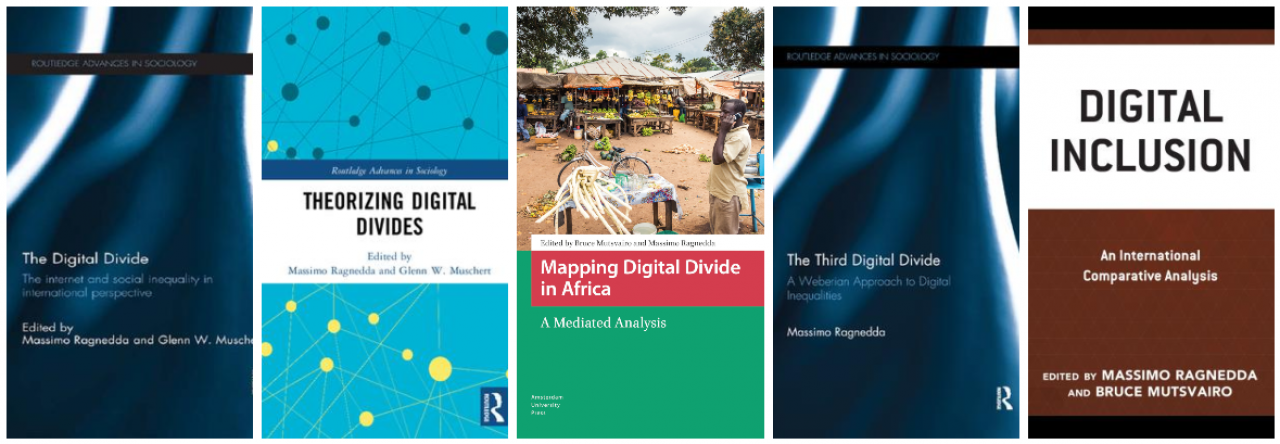
Massimo Ragnedda

Part of the Stanford/Elsevier Top 2% Scientist Rankings 2025

Theorizing Digital Divides and Inequalities.

61Y2jaSGDkL._SX331_BO1,204,203,200_

Massimo Ragnedda and Glenn W. Muschert, Theorizing Digital Divides and Inequalities, in  an Servaes, Toks Oyedemi (eds) Social Inequalities, Media and Communication: A Global perspective, 2016, Lexington Books

Inequalities that exist in the digital sphere are certainly entangled with inequalities present in the “social sphere”. The aim of this chapter is to sketch a concept of stratification and inequalities in the digital sphere, the goal of which is to clarify whether the digital divide simply extends traditional forms of inequality, or whether it also includes new forms, which might include counter-trends that alleviate traditional inequalities and/or which form new modalities of inequality. The discussion will proceed from a theoretical perspective using Max Weber’s theory of stratification, in order to clarify how social stratification in the digital age is reproduced online. The main idea is that inequalities in the digital sphere are based on features that, just as in the social sphere, go beyond the economic aspects of inequality.

6 fully-funded studentships available at Northumbria University

northumbria-logoTitle: Revisiting the digital divide: from social to digital inequalities.

Project Description: Defined as social and economic stratification in the access to- and use of- the internet, the digital divide is inevitably tied to the concept of social inequality. Systems of structured inequality exist in most human societies. Since more aspects of social life are migrating and expanding online, systems of structured inequality are being reproduced in the digital sphere: citizens without access to the internet (in terms of lack of equipment and infrastructural access) are likely to be disadvantaged when compared with their more networked neighbours. The project being advertised will incorporate both theoretical ideas and empirical analyses in order to bring fresh perspectives to debates around the forms of digital and social inequality and sketch a concept of inequalities in the digital sphere: the successful candidate will develop innovative ways through which to study digitally enabled networked societies. The connections between digital and traditional inequalities will be explored in order to better understand if the former perpetuates the latter, and how the latter informs the former. Indeed, despite the gradual closing of the digital gap over the past decade, significant differences remain in relation to the ways we use the internet, levels of digital literacy, issues of social capital and the development of ICT skills. All these factors influence how we use and experience the digital technologies around us and the benefits we derive from them.

2b4729_c872dbf6fd0a4a1ca2a7a8b2155e9686RAGNEDDA, Massimo and BUDD, Kristen M.: (2015) ‘Invisible Violence’: Media (Re)Production of Gender Inequality in Italy. Vol.4 – Nº7, pp. 11-21. ISSN 2014-6752. Girona (Catalunya)

Abstract: Compared to other European countries, opportunities are limited for Italian women to fully and equally participate in Italian social life. In order to better understand Italian women’s social position and gender inequality that persists in Italy, this research applies Pierre Bourdieu’s theory of symbolic violence. Specifically, symbolic violence is used to explain depictions of Italian women in the Italian media. Because social institutions such as the media, that reach large audiences, have the ability to transmit dominant cultural representations, they also transmit representations of the roles of masculinity and femininity. This ability permits media outlets to depict images of the gendered status quo. These representations and depictions often reinforce gender domination in the form of promoting and reifying gender inequality. This research uses the Global Media Monitoring Project and the European Observatory on Gender Representations report to analyse how the Italian media misrepresent and stereotype women in television and news by limiting their social roles and status in these outlets, a form of symbolic violence. These limited social roles are also seen in Italy’s social reality where women are less likely to be represented in different spheres of social life, like politics. These persistent and prevalent stereotypes and images in the Italian media reify the economic, social, and cultural disadvantage of women in Italy that contribute to continued masculine dominations in all spheres of social life. The implications of symbolic violence in the Italian media and media in general are then discussed. http://ojs.udg.edu/index.php/CommunicationPapers/article/view/212/MassimoRagnedda

Special Section on “Max Weber and Digital Divide Studies”: guest-edited by Massimo Ragnedda and Glenn W. Muschert

iweberm001p1

iweberm001p1

Seminal sociologist Max Weber rarely wrote about media dynamics; however, the Weberian perspective offers rich potential for the analysis of various media issues, including the study of digital divides. In particular, the contribution of a Weberian school of thought to the field is the addition of noneconomic and nontechnical concerns to the study of digital inequalities, most notably the importance of status/prestige, legitimacy, group affiliations, life chances, and political relations as areas of focus.

Facets of social life are migrating and expanding on-line, including the functioning of key social institutions; yet digital participation (like all other aspects of social life) remains unequal. A Weberian perspective allows a multifaceted view of such digital divides which include the interplay of social class (lifestyle and culture), social status (prestige and market influence), and power (political impact). Indeed, these key distinctions Weber identified about inequality are still significant and important in the digital age, although this perspective is in its nascent stage. This Special Section focuses precisely on the potential of applying Max Weber’s thought to digital divide studies.

Rethinking the digital divide (Keynote presentation, University of Exeter)

ExeterKeynote presentation: Rethinking digital divide, University of Exeter 03/06/2015 As more aspects of social life are migrating and expanding on-line, systems of structured inequalities are now well-entrenched and replicated in the digital sphere. However, the development of the theoretical aspect of digital divide studies has lagged behind the development of more empirical studies.  Traditional studies of digital divides have tended to be macro in scope, and often convey flavour of government reporting on infrastructure and electronic capacities.  Of course, there are many exceptions among scholars working in a variety of fields, however even given a variety of national and cultural perspectives from which such studies emerge, the theoretical underpinnings of such studies often proceed from a narrow range of perspectives (most commonly critical social theory perspectives, such as those in the Marxist and subsequent traditions).  While the critical schools have indeed brought great insight to the field, the narrow stretch of social theories applied to digital divides is surprising, given the diversity of theoretical developments which have developed in social theories, especially in the last half century.

Digital Inequalities: are social inequalities already existing in the society reproduced and reinforced online?

oxfOxford Internet Institute, Oxford University, 02/06/2015

Abstract: Social inequalities present in the social structures are not disconnected with the digital inequalities presents in the digital sphere. Digital inequalities, seen as the different skills at using information sources and opportunities, are embedded in social structures. Previous social inequalities not only affect digital divides but reinforce and exacerbate pre-existing social inequalities. Furthermore, several patterns which characterize and shape the social structure such as education, skills, income, occupation and gender influence the access and the use of the Internet. Analysed from this perspective it seems that social inequalities already existing in the society are reproduced and reinforced online. It might be argued that there exists a kind of recurring cycle between social and digital inequalities. Namely, social inequalities are the root of digital inequalities, and at the same time digital divides increase and reinforce social inequalities already present in a stratified social sphere. However, it is unclear whether the digital divide simply exacerbates traditional inequalities, or whether it also includes counter-trends that might mitigate traditional inequalities while forming new modalities of stratification.  Similarly, do traditional forms of inequality simply replicate themselves in the digital sphere, or does the digital divide operate under its own dynamics?

L’ISIS e la responsabilità dei media

Screengrab from the ISIS video showing the execution of James FoleyC’è un esercizio semplice semplice che tutti possiamo fare per capire quanto poco affidabile sia l’informazione mainstream (quella dei grandi giornali e delle TV). Prendete i giornali del 2011 (fate una piccola ricerca su google) e leggete le opinioni dei vari opinionisti di regime (Concita Degregorio, Ezio Mauro, De Bortoli, eccetera) e vedete come presentevano la guerra del 2011 contro Gaddafi: una rivolta per portare la pace e la democrazia. Ti mettevano di fronte ad un bivio (tipico del fascismo): o con noi o contro di noi, dove il noi stava per democrazia, libertà e giustizia. Come essere contro questi principi? Chi può dirsi contrario alla libertà? Chi può dirsi contrario alla democrazia? Se non accettavi la guerra del 2011 (e non fummo in tanti a protestare allora) eri con la dittatura, eri con Gaddafi ed eri ovviamente contro la democrazia. Tutti sapevamo che la caduta di Gaddafi avrebbe comportato l’avanzata dei terroristi, ma gli opinionisti di regime questo lo omettevano. Napolitano, tutelando gli interessi atlantisti e non quelli dell’Italia,  spinse su un riluttante Berlusconi che, per vari motivi, era contrario alla guerra. Guerra che per l’Italia è stata e sarà un disastro: economico (le aziende italiane hanno perso contratti milionari) politici (era forte l’influenza italiana in Libia) e sociali (difficoltà a gestire il flusso immigratorio). Ma questo gli opinionisti di regime non ce lo dicevano. La guerra era cosa già decisa: il loro compito era quello di presentarcela con un volto più suadente.

Theorizing Digital Divide: Call for chapter

My colleague Glenn Muschert (Miami Univ.) and I are editing a book on the topic “Theorizing Digital Divide.”

We are organizing an edited volume which will examine how theories may be useful in conceptualizing and studying digital inequalities. Contributions are invited for this edited international collection of original chapters engaging theoretical themes on digital inequalities.

Please see the attached Call for Chapter Proposals for details on the scope, timing, and mechanics of this project. Also, please feel welcome to post this call for papers widely and to forward it to interested colleagues and students. We hope to see some proposals from many of you, and for now, please feel welcome to be in contact if you have any questions for us.


I costi della TAV sono già lievitati (tangenti e mazzette costano).

no-tav-no-mafiaMa chi lo avrebbe mai detto? Il costo della TAV è già lievitato dagli 8.3 miliardi di euro iniziali agli 11.9 miliardi di euro di oggi. E siamo solo all’inizio. Considerando che questa inutile e dannosa opera che sventrerà una collina piena di amianto, sarà pronta tra non meno di 18 anni, ma probabilmente saranno 25 o 30, provate ad immaginare quanto lieviteranno i costi. Corruzione, mazzette, infiltrazioni della mafia e della camorra. Così si gonfiano i costi di un’opera inutile che farà arricchire politici corrotti e mafiosi. I nostri soldi, quelli delle tasse per intenderci, dirottati verso criminali e politici (sia del PD che del PDL) per realizzare un’opera che quando sarà pronta (se mai lo sarà) sarà oramai obsoleta e superata (chi diamine prenderà il treno tra 30 anni per andare da Torino a Lione? Ma che diamine ci vai a fare a Lione?). Investire 12 miliardi di euro (che diventeranno una ventina negli anni) per costruire un’opera inutile non è solo folle, ma criminale. Si potrebbero destinare questi soldi per la messa in sicurezza del territorio violentato (dove mazzette e corruzione hanno spinto vero la cementificazione selvaggia) o l’ammodernamento della rete ferroviaria nazionale. Ma in quel caso non ci sarebbero grossi appalti con le relative mega tangenti ai principali partiti italiani. 12 miliardi di euro rubati alla collettività, un assalto alla dirigenza che non può lasciarci indifferenti. Sono i nostri soldi che vengono depredati da corrotti e corruttori. Ma il problema nell’Italia renziana, si sa, è l’articolo 18.

Muri che cadono e muri che crescono

muroSono passati 25 anni dalla caduta del Muro di Berlino. Un quarto di secolo senza quel muro che, simbolicamente, ha rappresentato un’era, ha diviso il mondo e creato tensioni. Diverse celebrazioni hanno reso omaggio a quello che la Merkel ha definito un sogno che si è avverato. Ma da altre parti del mondo, non proprio così lontane da noi, un altro muro è stato costruito negli ultimi 10 anni. Un muro della vergogna, della segregazione razziale e dell’umiliazione per un intero popolo, è stato costruito in un paese che si affaccia sul Mediterraneo e che viene definito come “l’unica democrazia del Medio Oriente” . Un muro della vergogna , subito ribattezzato muro dell’Apartheid, che Israele ha costruito in territorio palestinese per segregare un intero popolo. Un muro che costringe centinaia di migliaia di persone a fare ore di fila nei check points militari delle forze di occupazione militare israeliane. Un muro che, come denuncia Amnesty International, “rappresenta una violazione costante del diritto internazionale, in quanto separa i palestinesi dalle loro terre agricole”.

Pagina 11 di 34

Powered by WordPress & Tema di Anders Norén