Despite issues associated with the digital divide, mobile telephony is growing on the continent and the rise of smartphones has given citizens easy access to social networking sites. But the digital divide, which mostly reflects on one’s race, gender, socioeconomic status or geographical location, stands in the way of digital progress. What opportunities are available to tame digital disparities? How are different societies in Africa handling digital problems? What innovative methods are being used to provide citizens with access to critical information that can help improve their lives? Experiences from various locations in several sub-Saharan African countries have been carefully selected in this collection with the aim of providing an updated account on the digital divide and its impact in Africa.
Reviews
“For many years ‘the digital divide’ has been a catchphrase, often with little analytical content. This book provides studies of how the concept can be understood within an African context. The different contributions address problems related to digital opportunities as well as inhibitions to growth; thus, it has implications for how to comprehend technological, political, economic, social, and cultural development in a wider world. Of particular importance is that the book provides a theoretical understanding as well as an account of the impact of different technologies such as mobile phones.” – Helge Rønning, Professor, Department of Media and Communications, University of Oslo, Norway
“You need to take a different perspective of both the digital divide and Africa to understand the complexity of social and digital inequality in Africa. The digital divide is different in every part of the world. Reading this book you will grasp the complexity of the social, cultural and political affairs of Africa that are reinforcing the digital divide. Surprisingly, while mobile telephony is booming here, ICTs are in fact only reinforcing existing social inequality.” – Jan A.G.M. van Dijk, Professor, Department of Communication, University of Twente, the Netherlands
“This is a timely and much-needed collection that fills an important gap in the literature. It offers excellent conceptual tools and a selection of case studies that provide a useful map of the digital divide across the African continent and between Africa and the rest of the world. I especially appreciate the editors’ efforts to address African issues on their own terms and to problematize interpretive paradigms from the global north. It is a book that many will look forward to reading. I will recommend it to my students.” – Pier Paolo Frassinelli, Professor, School of Communication, University of Johannesburg, South Africa
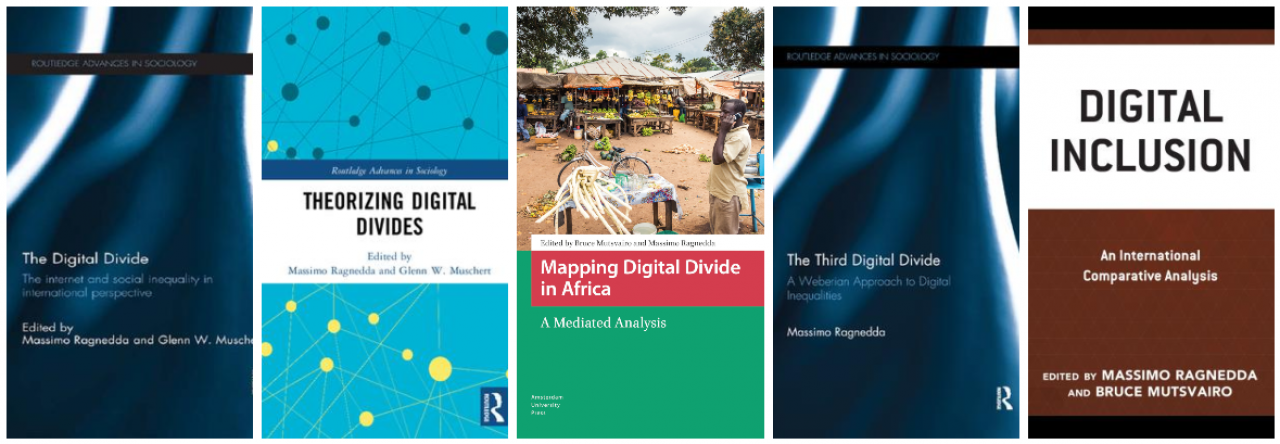
 The Digital Inclusion Policy and Research Conference 2019 (18 June to 19 June, London Campus of the University of Liverpool, University of Liverpool in London) brought together academic research with policy makers and stakeholders to review the current state for the art in digital inclusion policy and practice. DIPRC2019 drawn upon over two decades of research, policy, and practice. Over this time digital inequalities, digital inclusion and digital literacies have changed in response to developments in digital technologies and media. The primary aim of this conference was to link up international policy efforts to address digital inequalities, access and skills with the outcomes of recent research at from around the globe.
 I have been nominated by students for a teaching award. This the
  Next week (22-24 May 2019) I will be in Washington DC at the
  Bruce Mutsvairo, Massimo Ragnedda (eds).
  I am honoured to have been awarded title of Visiting Professor at the Faculty of Journalism, Lomonosov Moscow State University
 Call for papers: IAMCR 2019 Preconference/Special Issue Information, Communication and Society
 We have been receiving many great submissions to our Working Group in the past weeks. Looks like we’ll have lots of interesting discussions and presentations at IAMCR 2019, Madrid. You can still submit your abstract (both individual and panel proposals are welcome) before February 8, 2019 through
 On January 10-11 2019, I participated at the International Symposium “Wellbeing and Inequality in the Digital Age: New challenges and new possibilities”
  Massimo Ragnedda and Hanna Kreitem (2018)
  Are you interested in doing a Ph.D at Northumbria University, Newcastle? I am currently looking for strong candidates interested in bringing fresh perspectives to debates around the forms of digital and social inclusion and sketch a concept of inclusion and inequality in the digital sphere. The successful candidate will develop innovative ways through which to study how to counter social inequalities through digital inclusion. The successful researcher will use a case study approach to explore the ways in which digital literacy and digital skills programmes work together to challenge social inequalities and to propose a more nuanced understanding of how social and digital inclusion are related. I am open to applications bringing a variety of interpretations and suggesting different case study examples to this broad topic. Candidates should have an interest in equality issues and digital technologies. This project will be suitable for candidates with an MA or MFA in mass communication, media and sociology. Researcher who can bridge two or more of the above disciplines will be particularly well placed to apply for this doctoral studentship.