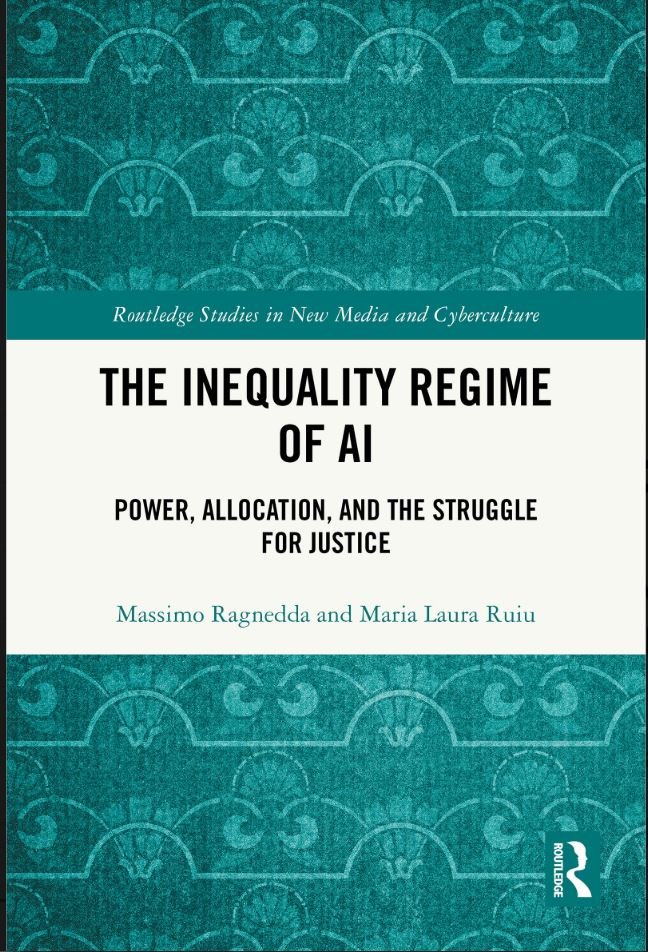
The Inequality Regime of AI
Power, Allocation, and the Struggle for Justice
Massimo Ragnedda & Maria Laura Ruiu
Routledge, 2027
A sociological account of how artificial intelligence reorganizes inequality through prediction, classification, infrastructure and institutional allocation.
Artificial intelligence does more than reproduce existing bias. It increasingly shapes how people and populations are classified, predicted and allocated opportunities, resources and risks. The Inequality Regime of AI develops a sociological framework for understanding this transformation, asking not only whether AI systems are fair, but who has the power to define what is predicted, control the infrastructures of prediction, act on algorithmic classifications and contest their consequences.
Moving beyond conventional digital-divide approaches, the book examines a shift from inequalities of access and participation toward inequalities of prediction and allocation. It develops the idea of an AI inequality regime to describe how data, models, computing infrastructures and institutional decision-making interact to distribute visibility, opportunities, resources and exposure to risk. Predictive systems do not simply reflect existing inequalities: once embedded in consequential institutions, they can participate in reorganizing and reproducing them.
The book connects these processes to broader questions of power and political economy, examining algorithmic habitus, environmental inequality, computational extraction, techno-colonialism and digital feudalism. It also moves beyond critique by considering alternatives based on critical AI literacy, algorithmic commons and redistributive infrastructures that could make predictive power more widely governed and contestable.
Read our introductory article on the book: The Inequality Regime of AI: How Artificial Intelligence Reorganises Power, Prediction and Justice.
Key Concepts
The AI Inequality Regime
AI is understood not simply as a set of tools or potentially biased models, but as a social, institutional, and infrastructural system through which data, algorithms, and governance shape visibility, value, voice, opportunities, resources, and risk. The concept captures how inequalities can become durable, normalized, and embedded in predictive systems and institutional decision-making.
Watch — Video Overview
Listen — Podcast Discussion
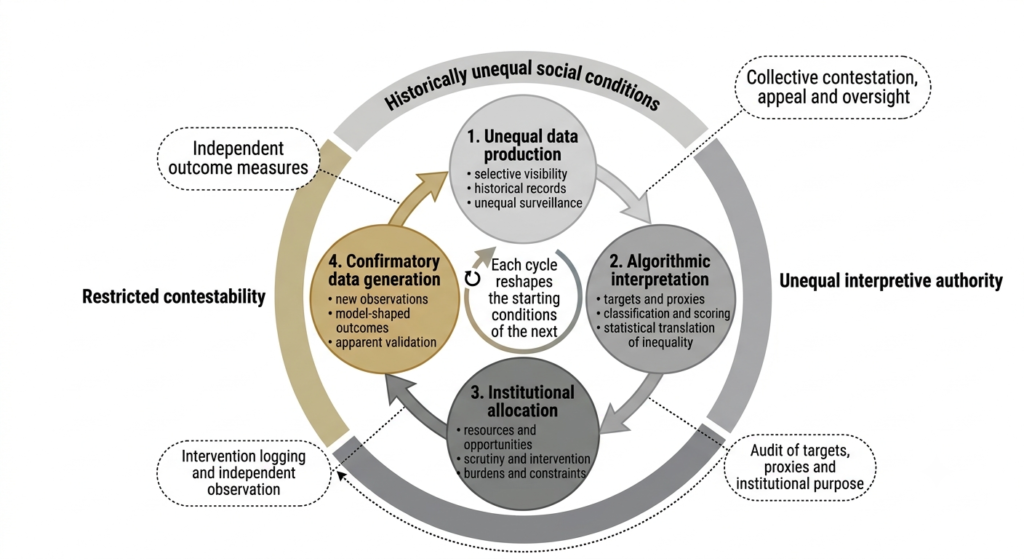
The AI Stratification Spiral
The AI Stratification Spiral describes how historical inequalities can become recursively embedded in predictive systems. Unequal social conditions shape data; data inform algorithmic classifications and predictions; predictions influence institutional decisions and the allocation of opportunities, resources and risk; and those decisions produce new outcomes and new data.
The crucial problem is that this new data may then appear to confirm the classifications that contributed to producing those outcomes. AI can therefore move from measuring an unequal reality to participating in the production of the reality it subsequently measures.
The concept shifts attention beyond isolated questions of algorithmic bias toward the relationship between social structure, data, prediction, institutional allocation and power over time.
Watch — Video Overview
Listen — Podcast Discussion
Read — Open-access paper
The AI Stratification Spiral: How Predictive Systems Turn Historical Inequality into Statistical Common Sense
DOI: 10.5281/zenodo.22111477 or Download the concept paper — Zenodo PDF
The Allocative Turn
The Allocative Turn describes the shift from digital inequalities centred on access, skills, and participation toward inequalities produced through prediction, classification, and allocation. As AI systems increasingly rank people, assess risk, determine eligibility, and distribute opportunities, the central question becomes not only who can use digital technologies, but who controls the systems that allocate life chances.
This shift changes the focus of digital inequality research. A person may be highly connected and digitally skilled while still being disadvantaged by systems that classify them as risky, ineligible, less employable, or less deserving of support. The issue is therefore no longer only participation in the digital world, but how automated classifications shape access to jobs, credit, education, welfare, healthcare, and other consequential opportunities.
At the heart of the Allocative Turn is a simple idea: prediction becomes socially powerful when institutions attach consequences to it.
Watch — Video Overview
Listen — Podcast Discussion
Algorithmic Habitus
Algorithmic Habitus describes how repeated interaction with algorithmically structured environments can shape dispositions, expectations, and everyday practices. Drawing on Bourdieu’s concept of habitus, it captures how people learn to anticipate rankings, recommendations, scores, and automated judgments and adjust their behaviour accordingly. Algorithmic power therefore operates not only through institutions, but also through how individuals perceive and present themselves.
Watch — Short Video and Video Overview
Listen — Podcast Discussion
Intelligibility Inequality
Intelligibility Inequality refers to unequal capacities to be accurately recognized, interpreted, and represented by computational systems. Some people and groups fit easily within dominant datasets and classificatory categories, while others may become misclassified, hyper-visible, or computationally invisible. The concept shifts attention from simple data inclusion to a deeper question: who has the power to define the categories through which people become machine-readable?
Watch — Short Video and Video Overview
Listen — Podcast Discussion
Digital Feudalism and Lex Digitalis
Digital Feudalism describes forms of dependency that emerge when powerful actors control the platforms, cloud infrastructures, models, interfaces, and digital environments on which others increasingly depend. Lex digitalis refers to the private rules embedded in code, algorithms, terms of service, ranking systems, and automated enforcement. Together, the concepts highlight how participation can become conditional on infrastructures and rules users do not control.
Computational Metabolism and Techno-colonialism
Computational Metabolism draws attention to the material foundations of artificial intelligence: energy, water, minerals, semiconductors, data centres, labour, and global supply chains. Techno-colonialism examines how these infrastructures can reproduce unequal geopolitical relations through data extraction, outsourced labour, resource dependency, and epistemic domination. Together, the concepts connect AI inequality to environmental, economic, and global structures of power.
Algorithmic Commons and Redistributive Infrastructures
Algorithmic Commons and Redistributive Infrastructures describe alternatives to concentrated control over data, computing capacity, knowledge, and predictive power. Rather than focusing only on correcting unfair outputs, these concepts ask how AI infrastructures themselves might be governed more collectively. Redistribution therefore includes material resources, epistemic authority, participation, ecological responsibility, and the capacity of affected communities to shape technological purposes.
Teaching and Academic Resources
These free teaching resources support instructors using The Inequality Regime of AI: Power, Allocation, and the Struggle for Justice in undergraduate, postgraduate, and doctoral teaching.
The materials are suitable for courses in digital sociology, media and communication, AI and society, science and technology studies, AI ethics, digital inequality, political sociology, environmental sociology, technology policy, and related areas.
The teaching kit introduces the book’s central argument that AI inequality cannot be understood only through access, skills, or algorithmic bias. It also requires attention to prediction, classification, allocation, institutional power, infrastructures, and governance.
All materials identify The Inequality Regime of AI by Massimo Ragnedda and Maria Laura Ruiu as the leading source.
Academic Seminar Reading Guide
Author-prepared guide
A concise guide to the book’s central argument, conceptual architecture, key concepts, theoretical relationships and questions of justice.
Designed for students, researchers and faculty preparing for a seminar, lecture or discussion on The Inequality Regime of AI.
Download the Academic Seminar Reading Guide (PDF)
The guide summarises the book without reproducing its text and is intended to support academic discussion
Free Teaching Resources
1. Quick Teaching & Adoption Guide
2-page PDF
A concise resource for instructors considering the book for their courses.
It includes:
- learning outcomes;
- key concepts and chapter suggestions;
- a ready-to-use 90-minute seminar;
- discussion questions;
- an AI allocation mapping exercise;
- suggestions for adopting the book in different teaching formats.
Download the 2-page Teaching & Adoption Guide
2. Expanded Teaching Guide
12-page PDF
A more detailed classroom companion designed primarily for a 90–120 minute class or seminar. The material can also be divided into two shorter sessions.
The guide includes:
- a complete teaching sequence;
- explanations of the book’s main concepts;
- reflective questions;
- classroom activities;
- case-based discussion prompts;
- assessment ideas;
- selected further reading;
- guidance on connecting individual concepts to specific book chapters.
The guide covers the AI Inequality Regime, Allocative Turn, AI Stratification Spiral, Algorithmic Habitus, Intelligibility Inequality, Digital Feudalism and Lex Digitalis, Computational Metabolism and Techno-colonialism, Algorithmic Commons, and Redistributive Infrastructures.
Download the Expanded Teaching Guide
3. Editable Teaching Deck
20-slide PowerPoint
A classroom-ready and fully editable slide deck providing a visual introduction to the conceptual architecture of the book.
The presentation is designed for a single 90–120 minute class, but it can also be divided into two sessions.
The slides include:
- key concepts and definitions;
- visual conceptual diagrams;
- reflective prompts;
- discussion questions;
- selected further reading;
- chapter references throughout;
- a final synthesis linking prediction, allocation, inequality, and redistributive alternatives.
Instructors are welcome to adapt the slides to their own course, teaching level, and classroom format.
Download the Editable 20-Slide Teaching Deck (.pptx)
How to Use the Teaching Kit
For one class: use the Expanded Teaching Guide and the full 20-slide presentation for a 90–120 minute introduction to AI, power, and inequality.
For two classes: divide the material between the diagnosis and mechanisms of AI inequality in the first session, and subjectivity, political economy, global inequalities, and alternatives in the second.
For individual topics: instructors may also use selected slides, concepts, questions, and activities alongside specific chapters from the book.
Leading Source
Ragnedda, M., & Ruiu, M. L. (2027). The Inequality Regime of AI: Power, Allocation, and the Struggle for Justice. Routledge.
DOI: 10.4324/9781003689379
The teaching materials are intended as companion resources to the book and do not replace the assigned chapters.
Considering the book for a course?
Request an inspection copy through Routledge.
Commentary and related research
Articles and research extending the arguments developed in The Inequality Regime of AI.
Tech Policy Press
AI Audits Need a Power Test, Not Just a Fairness Score
Massimo Ragnedda & Maria Laura Ruiu
Read the article →
London School of Economics (LSE) – British Politics and Policy / Inequalities Blog
AI inequality is not only about bias – it’s about who has the power to predict
Massimo Ragnedda & Maria Laura Ruiu
Read the article →
About the authors

Massimo Ragnedda
Professor of Media and Communication, University of Sharjah. Research on digital inequalities, digital capital and the societal consequences of AI. ORCID Google Scholar Research Gate
Maria Laura Ruiu
Associate Professor of Media and Communication, American University of Sharjah. Research on digital and environmental inequalities, communication, social capital and the societal consequences of AI. ORCID Google Scholar Research Gate
Citation and book details
Ragnedda, M., & Ruiu, M. L. (2027). The Inequality Regime of AI: Power, Allocation, and the Struggle for Justice. Routledge.
DOI: 10.4324/9781003689379
ISBN: 978-1-041-17368-7
For instructors, reviewers and media
Considering the book for a course? Request an inspection copy from Routledge. Reviewers and media professionals may also contact Routledge or the authors regarding review copies, interviews and related enquiries.