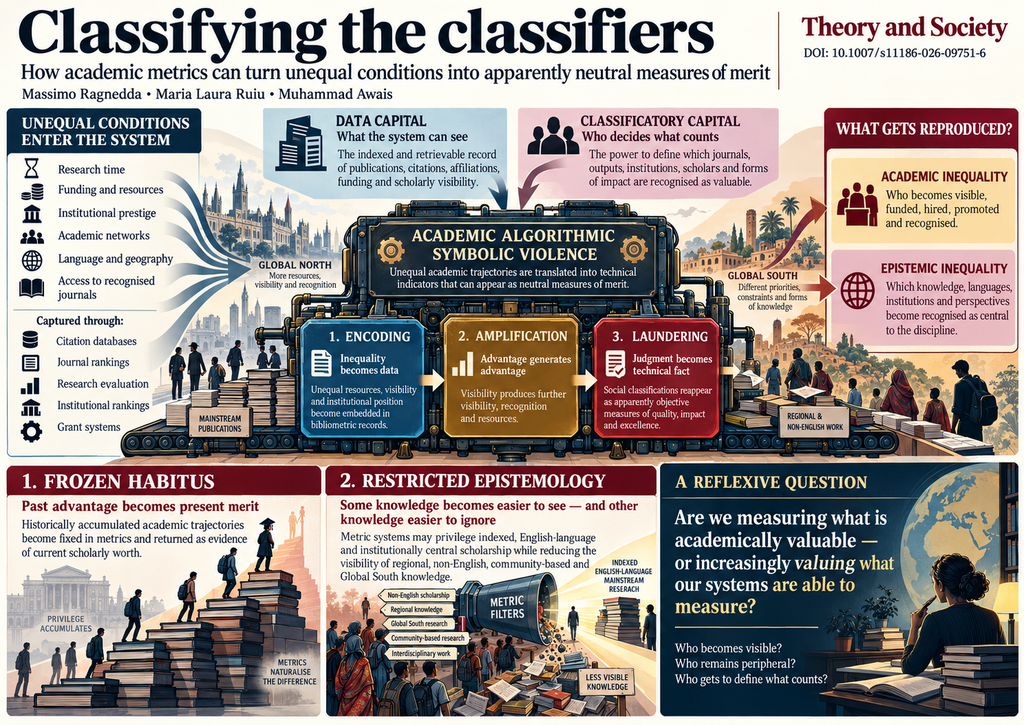
Academic algorithmic symbolic violence, data capital, classificatory capital, frozen habitus and restricted epistemology offer a new framework for understanding how bibliometrics, academic rankings and research evaluation may reproduce inequality in sociology and higher education.
Our new article, “Classifying the classifiers: academic algorithmic symbolic violence and the reproduction of stratification in sociology”, has been published in Theory and Society, co-authored by Massimo Ragnedda, Maria Laura Ruiu and Muhammad Awais.
DOI: 10.1007/s11186-026-09751-6
The article starts from a reflexive problem.
Sociologists have developed powerful analyses of classification, inequality and algorithmic decision-making in areas such as welfare, policing, credit, borders and public administration. But sociology has paid less attention to the classificatory infrastructures increasingly used to evaluate sociologists themselves.
Citation counts, h-indexes, journal rankings, bibliometric databases, institutional rankings, research dashboards and research assessment systems increasingly contribute to decisions about academic visibility, hiring, promotion, funding and prestige. Proof Theory and Society
Our question is therefore simple but uncomfortable:
What happens when systems designed to measure academic performance also participate in producing academic hierarchy?
Academic inequality is not simply measured after it happens
The central argument of the article is not that bibliometric systems independently create academic inequality.
Academic careers already develop under unequal conditions.
Researchers differ in their access to research time, funding, graduate assistance, mentoring, professional networks, institutional prestige, conference participation, editorial connections and internationally recognised publication venues. Scholars also work within unequal linguistic and geographic structures.
Algorithmic evaluation systems process records produced under these unequal conditions.
The problem emerges when indicators of visibility are treated as equivalent to scholarly quality.
Citation counts, institutional prestige and journal rankings may contain information about scholarly recognition, but they cannot by themselves establish the validity, originality or quality of research. The theoretical question is therefore when measurable recognition reflects scholarly contribution and when it also reflects accumulated institutional and social advantage. Proof Theory and Society
This distinction places academic inequality, bibliometric inequality, research evaluation and algorithmic classification within the same sociological problem.
Data capital: what academic systems can see
One concept introduced in the article is data capital.
Data capital refers to the accumulated, indexed and algorithmically retrievable record of academic activity.
It includes:
publications, citations, co-authorship networks, institutional affiliations, funding histories, downloads, professional activities and other metadata captured by systems such as Scopus, Web of Science and Google Scholar.
Data capital matters because academic work must increasingly become machine-readable, searchable, countable and comparable before it can circulate effectively through research evaluation systems.
But not every form of intellectual contribution is equally legible.
Research published outside major indexed journals, work in languages other than English, policy research, regional scholarship, community-engaged research and public sociology may have intellectual or social value while accumulating less data capital. Proof Theory and Society
The distinction is important:
academic value and data visibility are not necessarily the same thing.
Classificatory capital: who decides what counts?
A second concept is classificatory capital.
If data capital concerns what evaluation systems can see, classificatory capital concerns the power to determine what counts as valuable.
Who decides which journals are “top journals”?
Which databases define legitimate scholarly visibility?
Which indicators count as evidence of “impact”?
Which institutions are classified as prestigious?
Which forms of academic contribution become measurable?
Classificatory capital refers to the institutionalised authority to establish these categories of academic value. Rankings, citation indexes, journal classifications and evaluation systems do not simply organise information. They also establish the terms through which academic outputs become comparable and recognisable. Proof Theory and Society
This means that contemporary academic inequality involves not only unequal access to resources.
It also involves unequal power to define the categories through which academic merit is recognised.
Academic algorithmic symbolic violence
At the centre of the framework is the concept of academic algorithmic symbolic violence.
We use this term to describe the process through which historically unequal academic trajectories can be converted into apparently neutral differences in scholarly merit through algorithmically mediated evaluation.
The concept extends Pierre Bourdieu’s work on symbolic violence, academic capital, scientific capital and academic power to contemporary bibliometric infrastructures.
Academic algorithmic symbolic violence occurs when the social conditions that helped produce academic visibility become difficult to see once that visibility has been translated into metrics.
The resulting indicator may appear purely technical:
an h-index;
a citation count;
a journal quartile;
an institutional ranking;
an impact score.
But behind these apparently neutral measures lies a longer social history of resources, institutional position, language, networks, recognition and access.
The mechanism operates through three processes: encoding, amplification and laundering. Proof Theory and Society
Encoding: inequality becomes data
Encoding occurs when unequal academic conditions become incorporated into measurable records.
Bibliometric systems generally record outputs rather than the conditions under which those outputs were produced.
A citation count does not record whether a scholar had a low teaching load, research assistants, strong mentoring or international networks.
A publication list does not record unequal access to time, funding or professional sponsorship.
An institutional ranking does not record the long history of accumulated resources that helped produce current performance.
The inequality does not disappear.
It becomes encoded as data. Proof Theory and Society
Amplification: visibility produces more visibility
The second process is amplification.
Once academic advantage becomes measurable, it can become recursive.
Highly cited scholars become easier to discover and therefore potentially easier to cite again.
Highly ranked journals attract more submissions and attention.
Prestigious departments attract stronger resources, applicants, networks and funding.
Past recognition can therefore become an input into future recognition.
This connects academic algorithmic symbolic violence to longstanding research on cumulative advantage and the Matthew effect, while focusing specifically on the infrastructures through which accumulated recognition becomes searchable, comparable and institutionally actionable. Proof Theory and Society
Laundering: social judgments become technical outputs
The third process is laundering.
Academic evaluation necessarily contains judgments about value.
Which journals matter?
What counts as impact?
Which research audiences are important?
Which forms of knowledge deserve recognition?
When these decisions become embedded in rankings, metrics and dashboards, however, their classificatory origins may become less visible.
Social and institutional judgments can return as apparently impersonal numerical outputs.
A decision can then appear to follow naturally from “impact”, “citation performance” or “journal quality”, even though those categories themselves depend on prior decisions about what academic value means. Proof Theory and Society
Frozen habitus: when past advantage becomes present merit
The first broader consequence is frozen habitus.
Frozen habitus does not mean that Bourdieu’s habitus itself becomes static.
It refers instead to the way the bibliometric trace of an academic trajectory can become fixed in cumulative indicators.
Past institutional affiliation, mentoring, networks, publication opportunities and visibility become sedimented in academic profiles.
These historical trajectories can then return during hiring, promotion or funding decisions as indicators of current scholarly worth. Proof Theory and Society
Frozen habitus therefore introduces a temporal dimension into discussions of academic inequality:
past advantage can remain active inside present metrics.
Restricted epistemology: academic inequality becomes epistemic inequality
The second consequence is restricted epistemology.
This concept moves the argument beyond unequal academic careers.
Research evaluation systems may affect not only who receives recognition, but also which forms of knowledge receive recognition.
The article identifies inequalities in access to bibliometric and research intelligence systems themselves. Scholars at well-resourced universities may have greater access to the tools needed to analyse citation patterns, identify publication venues and strategically position their work. Researchers in less-resourced institutions may be evaluated through systems they have less capacity to access or inspect. Proof Theory and Society
A second issue concerns knowledge production.
When citation density, indexed publication and journal prestige become dominant signals of academic value, research that performs well within these systems may receive greater attention and resources.
Regional scholarship, non-English research, public sociology and community-oriented work may become less visible within dominant academic evaluation infrastructures.
The risk is that academia begins to confuse what is easily measurable with what is intellectually important.
Academic inequality, the Global South and epistemic justice
This issue has particular relevance for debates about Global South scholarship, global knowledge inequalities and epistemic justice.
The article’s descriptive analysis of leading sociology journals identifies strong geographic concentration in the United States and United Kingdom, alongside concentration among prestigious institutions and major Western funding organisations. The paper does not claim that algorithmic evaluation causes these patterns. It treats them as distributions requiring explanation. Proof Theory and Society
Scopus coverage itself is uneven across languages, regions, journals and publication types. English-language and internationally visible journals are better represented than many regional or non-English forms of sociology. Proof Theory and Society
This matters because global academic inequality may operate through two linked processes:
some scholars have fewer resources to produce internationally visible research;
and some forms of scholarship have fewer opportunities to become legible within dominant systems of evaluation.
This is why debates about bibliometrics increasingly connect with questions of epistemic inequality, epistemic injustice, Global North–Global South knowledge relations, language inequality, academic coloniality and the geopolitics of knowledge.
The framework does not assume that research produced outside dominant academic centres is automatically better, more original or more socially relevant.
The question is narrower:
Does comparable scholarship receive comparable opportunities for visibility, evaluation and recognition?
What the argument does not claim
The article does not argue that academic merit is meaningless.
It does not argue that highly cited scholars lack intellectual quality.
It does not argue that every ranking is illegitimate.
And it does not claim that algorithms independently create academic stratification.
Research quality matters.
Peer judgment matters.
Institutional selection matters.
Resources matter.
The argument concerns the additional role played by classification infrastructures when accumulated visibility becomes a proxy for scholarly worth. Proof Theory and Society
This distinction is important because it makes academic algorithmic symbolic violence an empirically testable proposition rather than a general criticism of metrics.
A research agenda for bibliometrics, sociology of knowledge and higher education
The framework creates several directions for future research.
Researchers can examine whether comparable publications receive different levels of recognition depending on institutional prestige or prior visibility.
They can analyse whether anonymised evaluation reduces prestige effects.
They can study how hiring, promotion and funding committees use metrics in practice.
They can investigate language bias, database inclusion, journal classification and the visibility of non-Anglophone research.
They can compare different national research evaluation systems and examine when data capital becomes more or less convertible into scientific capital and academic power.
These questions connect the article to several established research areas:
bibliometrics; research assessment; sociology of science; sociology of knowledge; higher education studies; academic stratification; cumulative advantage; Bourdieu and field theory; algorithmic inequality; platform power; academic capitalism; epistemic justice; Global South scholarship; knowledge inequality; citation inequality; academic prestige; journal rankings; research metrics; and responsible research assessment.
Classifying the classifiers
The broader argument is ultimately reflexive.
Sociology studies classification.
Sociology studies hierarchy.
Sociology studies inequality.
Sociology increasingly studies algorithms.
But sociology must also examine the infrastructures through which its own scholars, institutions and forms of knowledge are classified.
The central question is therefore not simply whether academic metrics are accurate.
It is:
Are we measuring what is academically valuable—or increasingly valuing what our systems are able to measure?
Before we classify scholars, journals and institutions, perhaps we should begin by classifying the classifiers.