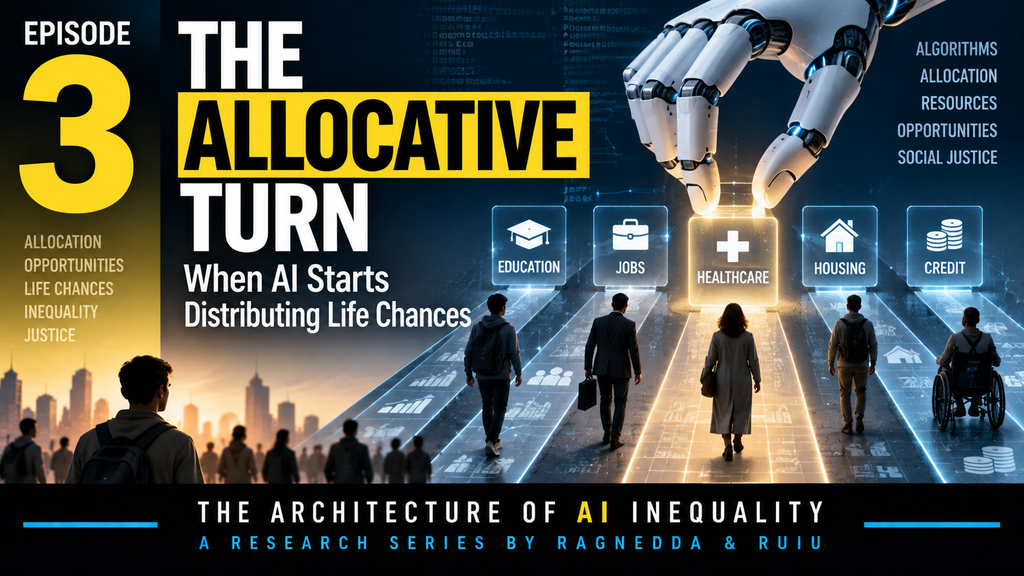
For much of the history of digital inequality research, the central questions concerned access, skills, use, participation, and outcomes. Who could connect to the internet? Who possessed the skills required to use digital technologies? Who could convert digital resources into educational, economic, social, or political advantages?
Artificial intelligence does not make these questions obsolete. It adds another one:
What happens when digital systems no longer simply provide environments in which people participate, but increasingly classify people and help institutions decide what they receive?
This shift is captured by the concept of The Allocative Turn, developed by Massimo Ragnedda and Maria Laura Ruiu in The Inequality Regime of AI: Power, Allocation, and the Struggle for Justice.
The Routledge book explicitly locates the concept in the transition from digital divides toward inequalities of prediction and allocation, with a chapter titled The Roots of AI Inequality: From Digital Divides to the Allocative Turn. Routledge
What is the Allocative Turn?
The Allocative Turn describes the shift from digital inequalities centred primarily on access, skills, participation, and the conversion of digital resources into benefits toward inequalities increasingly produced through prediction, classification, ranking, and allocation.
The concept identifies a change in what digital systems do socially.
Earlier debates about digital inequality were largely concerned with whether people could enter and participate in digital environments.
AI-mediated systems increasingly do something additional.
They evaluate.
They predict.
They rank.
They classify.
And institutions may use these classifications to distribute opportunities, resources, attention, support, scrutiny, or risk.
The central question therefore changes from:
Who can participate in the digital world?
to:
Who controls the systems that classify people and allocate life chances?
That is the Allocative Turn.
From digital participation to algorithmic allocation
Digital participation remains unequally distributed.
People still differ in access to technologies, quality of connectivity, digital skills, confidence, motivation, and capacity to transform digital engagement into social benefits.
But AI introduces a different form of inequality.
A person may have excellent internet access.
They may be highly digitally skilled.
They may use AI frequently and effectively.
They may possess high levels of digital capital.
None of this guarantees that the person will be favourably classified by an AI-mediated institutional system.
A digitally competent applicant may still be ranked as a weak employment candidate.
A highly connected consumer may still be classified as financially risky.
A skilled student may still receive an unfavourable predictive assessment.
A citizen may have extensive digital access while being categorised as ineligible for a service or selected for additional scrutiny.
The important distinction is between having the capacity to use digital technologies and having power over the systems that use data to classify you.
The Allocative Turn shifts digital inequality research toward this second problem.
Prediction becomes powerful when institutions attach consequences to it
The central proposition of the Allocative Turn can be expressed in one sentence:
Prediction becomes socially powerful when institutions attach consequences to it.
An algorithmic prediction is not automatically an allocation.
A model might estimate the probability that someone will repay a loan, perform well in employment, complete a university programme, require healthcare intervention, breach a rule, or respond to a particular service.
The prediction becomes socially important when an institution acts on it.
A bank may alter access to credit.
An employer may decide who reaches the next stage of recruitment.
A university may identify students for intervention.
A welfare agency may prioritise or scrutinise particular cases.
A healthcare organisation may rank patients according to predicted need.
A platform may distribute visibility differently across users or content.
The sociological significance therefore lies not simply in what AI predicts, but in the connection between prediction and institutional action.
This is why the Allocative Turn is fundamentally a concept about power.
Classification is not the same as allocation
The distinction between classification and allocation is important.
Classification produces categories.
Allocation connects those categories to outcomes.
A person can be classified as low risk, high risk, employable, unsuitable, relevant, suspicious, eligible, or unlikely to succeed.
Those labels become socially powerful when institutions use them to decide:
who receives an opportunity;
who receives a resource;
who is prioritised;
who waits;
who pays more;
who receives greater scrutiny;
or who is excluded.
This connection transforms computational categories into differences in life chances.
The Allocative Turn therefore encourages researchers to examine not simply whether algorithmic categories are accurate, but what happens after classification.
Why the Allocative Turn is different from algorithmic bias
The concept should not be reduced to algorithmic bias.
Bias asks whether a system treats different groups unequally or produces systematically distorted outcomes.
The Allocative Turn asks a broader institutional question:
Why does a classification matter, and which organisation has the authority to act upon it?
Imagine that a predictive model becomes more statistically accurate.
This does not remove the allocative question.
The system still operates within an institution that must decide what the prediction means and what should happen because of it.
Who determines the threshold separating acceptable from unacceptable risk?
Who decides which variables count as indicators of employability?
Who defines eligibility?
Who determines how a ranking should affect access to services?
Who can challenge the decision?
A perfectly calibrated prediction could still become part of an unequal allocative structure.
Technical accuracy and social justice are therefore not identical questions.
The Allocative Turn and the digital divide
The Allocative Turn is best understood as an extension of digital inequality research rather than a rejection of it.
Digital-divide scholarship progressively moved from the first level, centred on access, toward the second level, concerned with skills and forms of use, and then toward the third level, concerned with unequal outcomes and benefits.
Ragnedda and Ruiu’s earlier work on digital capital similarly examined how digital resources and competences interact with social inequalities and can be converted into advantages across different areas of life. Their 2020 book Digital Capital provides the theoretical framework connecting digital resources to broader forms of social advantage. Emerald Publishing
The Allocative Turn adds another layer.
The issue is no longer only whether people successfully convert their digital resources into benefits.
AI-mediated institutions may increasingly intervene in that conversion by ranking, filtering, predicting, and allocating.
Digital inequality therefore moves from a question about people’s resources toward a question that also concerns institutional classificatory power.
Allocation and life chances
The idea of life chances is especially useful here.
Employment, education, credit, housing, welfare, healthcare, insurance, public services, and visibility can all affect people’s trajectories.
When predictive systems become embedded in these areas, algorithmic classification can influence access to resources that matter far beyond the immediate digital interaction.
The Allocative Turn therefore asks researchers to follow AI systems outward.
The object of study should not stop at the model.
Researchers need to examine the institutional chain connecting:
data → classification → prediction → decision → allocation → social outcome.
That chain is where computational outputs acquire social force.
Employment
Employment provides a clear example.
Digital inequality research might examine whether applicants have access to online recruitment systems or possess the skills necessary to navigate them.
The Allocative Turn asks additional questions.
How are candidates ranked?
Which characteristics are treated as signals of suitability?
Which applicants are filtered before a human recruiter sees them?
How are gaps in employment, educational credentials, location, language, or previous career trajectories interpreted computationally?
Most importantly:
What happens to the applicant after the classification is produced?
The allocation of interviews, attention and employment opportunities becomes part of the analysis.
Credit and financial services
The same reasoning applies to credit.
Digital access may allow a person to apply for financial products online.
But participation in the system does not guarantee equal treatment within it.
Predictive systems can classify applicants according to estimated risk.
The Allocative Turn directs attention to how such classifications affect access to credit, borrowing conditions, pricing, scrutiny, or exclusion.
The inequality may therefore arise not from inability to access the digital service, but from how the person is interpreted once inside it.
Education
In education, predictive analytics can be used to assess performance, engagement, retention, progression, or risk.
Again, the key issue is not merely prediction.
An institutional prediction may trigger additional support, intervention, monitoring, exclusion from opportunities, or different expectations.
The same prediction might therefore produce very different social effects depending on how an institution interprets and acts upon it.
The Allocative Turn consequently directs attention toward the institutional consequences attached to educational prediction.
Welfare and public services
Automated or AI-assisted systems in public administration raise similar questions.
A citizen may possess the skills required to access a digital welfare system while having little influence over the categories through which eligibility or risk is assessed.
The relevant inequality is therefore no longer adequately captured by digital access alone.
It also concerns:
who defines eligibility, who is scrutinised, what counts as risk, how decisions are made, and what mechanisms exist for contesting them.
Allocation is especially important in these contexts because public institutions possess authority over resources and services on which people may depend.
Healthcare
AI applications in healthcare often involve prediction and prioritisation.
Systems may estimate risk, classify needs, support triage, or identify patients for particular interventions.
These applications can provide benefits.
The Allocative Turn does not presume that algorithmic allocation is necessarily unjust.
Instead, it asks researchers to investigate how prediction becomes connected to institutional distribution.
Who receives attention first?
What indicators shape assessments of need?
Which populations fit the available categories well?
Who can contest an incorrect classification?
The empirical question is therefore not whether AI allocation is always harmful.
It is how allocative systems redistribute opportunities, resources and risk across different populations.
Visibility is also allocated
Allocation does not refer only to money, employment, welfare, or services.
Digital platforms allocate attention and visibility.
Ranking and recommender systems affect what people see and whose content receives exposure.
Search systems organise prominence.
Platforms decide which signals influence relevance.
In these environments, visibility itself becomes a scarce resource.
The Allocative Turn therefore also applies to the distribution of attention, recognition and communicative opportunity.
The relevant question becomes not simply whether someone can post, participate, or create content, but whether algorithmic systems make that participation visible.
Participation and visibility are not the same thing.
Why allocation can reproduce inequality
Predictive systems typically operate on data generated within societies that are already stratified.
Employment histories reflect unequal labour markets.
Financial histories reflect unequal distributions of wealth.
Educational records reflect unequal opportunities.
Health data reflect unequal exposure to social and environmental risks.
These data can then become inputs into predictive systems.
When institutions use predictions based on historically structured data to allocate new opportunities, existing inequalities may enter future decisions.
The problem is not that every prediction necessarily reproduces the past.
The more precise concern is that historical inequality can become relevant to future allocation through computational classification.
This is why the Allocative Turn links prediction to social stratification.
Allocative power
At the centre of the concept is allocative power.
Allocative power is the capacity to influence who receives what, under which conditions, and with what consequences.
AI can redistribute this power.
Those controlling data, models, categories, decision thresholds, infrastructures, and institutional rules may acquire greater capacity to structure the opportunities available to others.
Those who are classified may have considerably less capacity to understand, negotiate, or challenge those processes.
The inequality therefore involves not merely different outcomes but an asymmetry between:
those who classify and those who are classified;
those who predict and those who are predicted;
those who allocate and those whose opportunities are allocated.
The Routledge description of The Inequality Regime of AI explicitly frames the book as moving from inequalities of participation toward inequalities of prediction, with the Allocative Turn forming a central part of that transition. Routledge
The Allocative Turn is not technological determinism
The concept does not claim that AI inevitably produces unequal outcomes.
Such a claim would remove precisely the institutional variation that the Allocative Turn is intended to make visible.
Different organisations can use identical predictions differently.
Different regulatory arrangements can produce different safeguards.
Human oversight can vary.
Appeal mechanisms can vary.
The distribution of benefits can vary.
Predictive systems can also be used to identify need and redistribute resources toward disadvantaged groups.
The point is therefore not that allocation through AI is inherently unjust.
The point is that AI increasingly enters institutional processes through which social goods, opportunities and risks are distributed.
Once this occurs, allocation becomes a central object of digital inequality research.
How can researchers study the Allocative Turn?
The concept can be operationalised through a relatively direct set of empirical questions:
- What is being predicted or classified?
- Which data enter the prediction?
- Who defines the categories and decision thresholds?
- Which institution uses the prediction?
- What resource, opportunity, burden, or risk is allocated?
- Who benefits from the allocation?
- Who is disadvantaged?
- Which groups are more frequently exposed to classification?
- Can individuals understand why they received a particular outcome?
- Can they challenge the classification?
- What happens when the prediction is wrong?
- How much discretion remains with human decision-makers?
- Does the system reproduce previous institutional patterns or alter them?
- Who controls the infrastructure through which allocation occurs?
These questions make the Allocative Turn suitable for research across sociology, media and communication, digital inequality, AI governance, public policy, education, labour studies, health, welfare, finance, platform studies, and science and technology studies.
Why the Allocative Turn matters for digital inequality research
Digital inequality scholarship has progressively expanded its object of analysis.
Access was not enough.
Skills were not enough.
Participation was not enough.
Outcomes became necessary.
Artificial intelligence now requires another extension.
A society in which everyone possesses digital access would not necessarily be a society free from digital inequality.
A population could be universally connected and digitally skilled while remaining unequally classified by predictive institutions.
This is the central insight of the Allocative Turn.
Digital inclusion does not eliminate allocative inequality.
A person can be digitally included while being algorithmically disadvantaged.
The distinction matters because policies centred entirely on access and digital literacy may fail to address inequalities produced by systems that operate on people rather than merely for them.
From “Can people use AI?” to “How does AI act upon people?”
The Allocative Turn can therefore be understood as a change in analytical perspective.
One set of questions concerns people’s relationship to technology:
Can they access it?
Can they use it?
Do they possess adequate skills?
Can they benefit from it?
The Allocative Turn adds a second set of questions concerning technology’s institutional relationship to people:
How are they classified?
What is predicted about them?
How are they ranked?
What consequences follow?
What opportunities are distributed differently because of those predictions?
These two dimensions should not be separated.
The same individual can be privileged on one and disadvantaged on the other.
Someone may be a sophisticated AI user while simultaneously occupying a weak position within an institutional predictive system.
The central question of the Allocative Turn
The concept ultimately directs attention toward a basic sociological issue:
Who has the power to transform predictions into consequences?
That is where AI moves from computation into social stratification.
Models produce scores.
Institutions produce consequences.
The two become sociologically significant when they are connected.
This is why the Allocative Turn is not simply a concept about algorithms.
It is a concept about institutions, distribution and power.
The Allocative Turn in one sentence
The Allocative Turn describes the shift from digital inequalities centred on access, skills and participation toward inequalities increasingly produced when AI-mediated prediction, classification and ranking become connected to institutional decisions that allocate opportunities, resources, visibility and risk.
Who developed the concept of the Allocative Turn?
The concept is developed by Massimo Ragnedda and Maria Laura Ruiu in The Inequality Regime of AI: Power, Allocation, and the Struggle for Justice. The book dedicates a chapter to The Roots of AI Inequality: From Digital Divides to the Allocative Turn and places allocation at the centre of its account of the transition from inequalities of participation toward inequalities of prediction. Routledge
How to cite the Allocative Turn
For use of the Allocative Turn as a conceptual framework, cite:
Ragnedda, M., & Ruiu, M. L. (2026). The Inequality Regime of AI: Power, Allocation, and the Struggle for Justice. Routledge. https://doi.org/10.4324/9781003689379
Further resources on the Allocative Turn
Watch — Video Overview
https://youtu.be/wU2sH8iM82o
Listen — Podcast Discussion
https://open.spotify.com/episode/7b03pRE3XmM3wg5YXhmryw?si=yfo8a2PVQ5C2JGcukLeOUw
Explore — The Inequality Regime of AI: full conceptual framework
https://www.massimoragnedda.com/the-inequality-regime-of-ai/