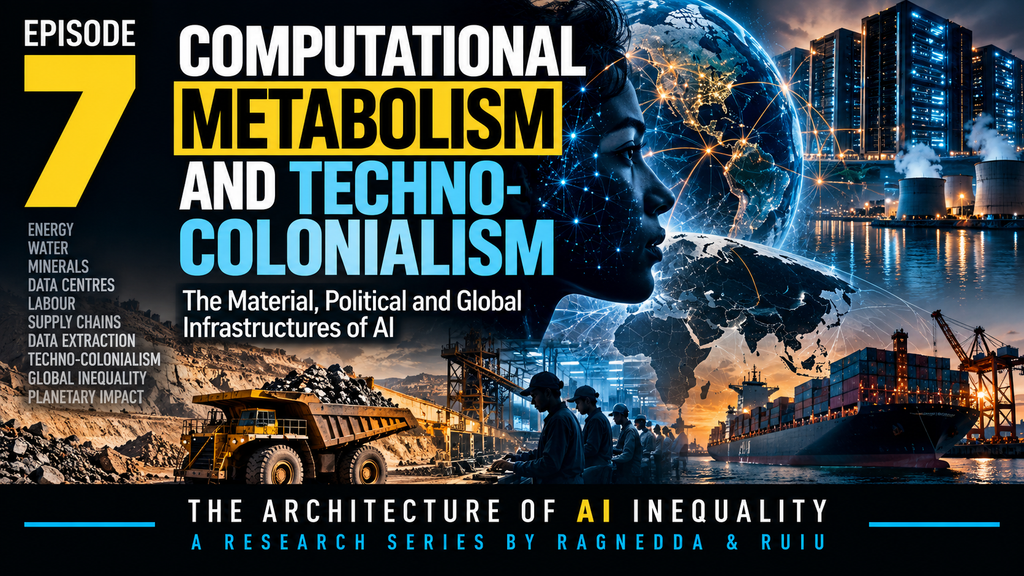
Models operate “in the cloud.” Data travel through networks. Algorithms calculate, predict and generate seemingly without physical form.
But artificial intelligence is profoundly material.
Every model depends on infrastructures that require electricity, water, minerals, semiconductors, servers, data centres, telecommunications systems, human labour and global supply chains.
Recognising these foundations changes how we understand AI inequality.
In The Inequality Regime of AI: Power, Allocation, and the Struggle for Justice, Massimo Ragnedda and Maria Laura Ruiu use the concepts of Computational Metabolism and Techno-colonialism to connect artificial intelligence to environmental inequality, extraction, labour, geopolitical dependency and epistemic power. The book explicitly situates these questions within its section on “Global Orders of Extraction,” including chapters on environmental inequalities and techno-colonialism. Routledge
A concise distinction captures their relationship:
Computational Metabolism identifies the material and labour flows that make AI possible.
Techno-colonialism examines the unequal relations of extraction, dependency and control through which those flows can be organised.
Together, the concepts ask a question that is frequently absent from debates about AI:
Who supplies the resources, labour and environments required for artificial intelligence, and who captures the benefits produced from them?
What is Computational Metabolism?
Computational Metabolism refers to the continuous material, energetic and labour processes required to produce, operate and reproduce computational systems such as artificial intelligence.
The concept challenges the tendency to treat digital technologies as immaterial.
Artificial intelligence may appear on a screen as text, images, recommendations or predictions, but those outputs depend on extensive physical systems.
AI requires electricity to train and operate models.
Data centres require energy and cooling.
Computing hardware depends on minerals, metals and highly specialised semiconductor production.
Data infrastructures require servers, cables, networks and storage systems.
AI development also depends on human labour: from engineering and research to data preparation, annotation, content moderation, maintenance and logistical work.
A computational system therefore does not simply process information.
It continuously draws resources from social and ecological environments and transforms them into computational capacity.
This is why the metaphor of metabolism is useful.
Why “metabolism” rather than environmental footprint?
An environmental footprint normally measures the environmental effects associated with a product, activity or organisation.
Computational Metabolism asks a broader question.
It focuses on the flows and relationships required to keep computational systems operating.
The concept therefore directs attention not only to how much electricity an AI system consumes, but to the complete organisation of resources supporting it.
Where does energy come from?
Where is water used?
Where are minerals extracted?
Where are semiconductors fabricated?
Where are servers located?
Who performs the labour supporting AI systems?
How are components transported?
Where does obsolete hardware go?
Which regions capture economic value, and which regions absorb environmental costs?
Seen from this perspective, AI is not simply computational.
It is ecological, industrial and social.
The publisher’s description of The Inequality Regime of AI similarly characterises the book’s computational metabolism as connecting AI infrastructures to resource extraction and planetary environmental pressures. Routledge
Energy, water and computational capacity
Artificial intelligence requires computing capacity, and computing capacity requires physical resources.
The relationship between AI and energy is therefore not external to technological development. Energy is one of the conditions making computation possible.
The same applies to water.
Cooling systems, electricity generation and semiconductor production can all create demands on water resources. The environmental significance of these demands depends heavily on location.
A data centre operating in one geographical context may interact with very different energy systems, water availability and local ecological pressures from an identical facility elsewhere.
Computational Metabolism therefore encourages researchers to move beyond aggregate consumption and ask where consumption occurs and how its costs are socially distributed.
Environmental pressure becomes an inequality question when the communities experiencing resource demands or ecological costs are not the same actors capturing most of the value generated by computational systems.
Minerals, semiconductors and the hidden materiality of AI
The apparent immateriality of artificial intelligence also hides its dependence on hardware.
AI models require processors, memory, storage systems, networks and data centres.
These infrastructures depend on minerals, industrial production and highly specialised semiconductor supply chains.
The physical history of an AI output therefore begins long before a user types a prompt.
It includes extraction, refining, manufacturing, transport, assembly, infrastructure construction and energy production.
Computational Metabolism connects these stages.
Rather than treating a model as an isolated technological object, it treats AI as part of a wider material system of production and circulation.
This changes the unit of analysis.
The relevant object is no longer simply the algorithm.
It becomes the network of resources, infrastructures and labour without which the algorithm could not operate.
Human labour is part of Computational Metabolism
The concept also prevents AI from being represented as entirely automated.
Computational systems depend on human labour.
Some of this labour is highly visible: engineers, researchers and technical specialists.
Other forms are less visible.
Datasets may require collection, cleaning and annotation.
Outputs may require evaluation.
Platforms may require moderation.
Hardware must be manufactured, transported, installed and maintained.
Data centres require workers.
Supply chains require logistical labour.
Computational Metabolism therefore includes human labour alongside energy and material resources.
This point matters for AI inequality.
The public image of artificial intelligence often concentrates attention on highly valued technical labour while obscuring lower-paid or geographically distant work that supports computational production.
Making this labour visible is therefore part of making AI’s material organisation visible.
From Computational Metabolism to Techno-colonialism
Recognising the resources required by AI leads to another question.
How are those resources organised globally?
A supply chain may be global without necessarily being unequal.
International technological cooperation is not automatically colonial.
The concept of Techno-colonialism becomes useful when technological development involves persistent asymmetries in extraction, dependency, ownership, value capture and epistemic authority.
Within The Inequality Regime of AI, Techno-colonialism is used to examine how AI infrastructures can reproduce unequal global relations through data extraction, labour, resource dependency and epistemic extractivism. The book dedicates a full chapter to this formulation. ResearchGate
What is Techno-colonialism?
Techno-colonialism describes technological relationships in which powerful actors can extract resources, data, labour or knowledge from other populations while retaining disproportionate control over infrastructures, standards, technological development and the value generated from them.
The concept does not require territorial occupation in the historical colonial sense.
Its focus is instead on structural relationships.
A country may supply resources without controlling the technologies built from them.
Workers may supply labour without sharing proportionately in the economic value it creates.
Populations may produce data while possessing little influence over the systems trained on those data.
Institutions may adopt technologies that they cannot independently inspect, reproduce or modify.
Languages and knowledge systems may become incorporated unequally into AI models.
These relationships can generate forms of technological dependency even where political sovereignty formally remains intact.
Techno-colonialism has a wider genealogy
The expression should not be treated as though it originated with The Inequality Regime of AI.
There is an established body of work on digital colonialism, data colonialism, technological colonialism and related concepts. Recent scholarship has traced the development of these ideas across communication, sociology, law, anthropology, computing and political theory. OUP Academic Earlier work has also explicitly used techno-colonialism to discuss the transfer of technologies and embedded values between unequal geopolitical contexts. Journals
The contribution developed by Ragnedda and Ruiu is therefore more specific.
It connects techno-colonialism to AI inequality by examining the relationship between data, labour, environmental extraction, infrastructure and epistemic authority.
This distinction matters because coloniality in AI cannot be understood through data extraction alone.
It is simultaneously material, economic, infrastructural and epistemic.
Data extraction
Artificial intelligence depends on data.
When populations generate data that are collected, processed and transformed into commercial or institutional value elsewhere, questions emerge about ownership and control.
Who produces the data?
Who stores them?
Who determines how they are interpreted?
Who builds models from them?
Who captures the resulting economic value?
Who can refuse their use?
The problem is therefore not data collection by itself.
It is the asymmetry between data production and control over the infrastructures that transform data into predictive power.
Labour extraction
The same asymmetry can affect labour.
AI development may distribute tasks across global labour markets while concentrating ownership and value capture elsewhere.
This makes outsourced labour important to techno-colonial analysis.
The relevant question is not simply whether work crosses borders.
It is whether the distribution of labour, compensation, decision-making authority and economic value produces persistent relations of dependency.
Computational Metabolism makes the labour visible.
Techno-colonialism asks how that labour is positioned within global structures of power.
Resource dependency
AI infrastructures also depend on material extraction.
Minerals, energy, land, water and industrial capacity are geographically distributed.
Their economic and environmental effects are therefore also geographically distributed.
A techno-colonial perspective asks whether some regions become primarily suppliers of resources while others retain greater control over high-value technological infrastructures, intellectual property, computational capacity and markets.
This can create a familiar asymmetry:
resources and environmental costs are dispersed, while ownership and technological control remain concentrated.
Infrastructural dependency
Technological dependency does not operate only through raw materials.
Governments, universities, businesses and public institutions may become dependent on externally controlled cloud platforms, models, software ecosystems or computational infrastructures.
An institution may therefore possess formal authority over a decision while lacking meaningful control over the technical infrastructure enabling that decision.
This matters because dependency limits autonomy.
An actor that cannot independently reproduce, modify or replace essential technological infrastructure may have less capacity to determine how that infrastructure evolves.
Techno-colonialism therefore concerns not only extraction but also who possesses the capacity to build, govern and replace technological systems.
Epistemic domination
Perhaps the least visible dimension is epistemic.
Artificial intelligence does not merely process resources and data.
It also processes categories, languages, meanings and knowledge.
AI systems are trained within particular classificatory structures.
Some languages are more extensively represented than others.
Some forms of knowledge are more easily encoded.
Some categories become standardised.
Some understandings of the world acquire greater computational visibility.
This produces an important question:
Who gets to define the categories through which the world becomes machine-readable?
Techno-colonialism therefore includes epistemic power: the capacity to make particular knowledge systems, languages and classifications appear universal while others remain marginal, poorly represented or dependent on externally produced technological standards.
How Computational Metabolism and Techno-colonialism connect
The relationship between the concepts can be expressed simply:
Computational Metabolism maps the flows. Techno-colonialism maps the power relations organising those flows.
Computational Metabolism asks:
What resources sustain AI?
Techno-colonialism asks:
Who controls those resources and the infrastructures into which they flow?
Computational Metabolism asks:
Whose labour supports AI?
Techno-colonialism asks:
Where is labour located relative to ownership and value capture?
Computational Metabolism asks:
Which data and knowledge feed computational systems?
Techno-colonialism asks:
Who has authority to transform that data and knowledge into categories, predictions and technological standards?
The two concepts therefore connect AI inequality to environmental inequality and global inequality.
Not every global AI relationship is techno-colonial
The concept requires analytical discipline.
Calling every technological inequality “colonialism” would weaken its explanatory value.
A techno-colonial relationship should involve more than simple technological difference.
Researchers should look for combinations of:
- asymmetric extraction of resources, data or labour;
- concentration of ownership and technological capacity;
- infrastructural dependency;
- unequal distribution of environmental burdens and economic benefits;
- limited capacity for local actors to shape technological purposes;
- epistemic hierarchies that privilege particular languages, categories or knowledge systems.
The empirical question is therefore not whether AI is inherently colonial.
It is:
Under what conditions do AI infrastructures reproduce relations of extraction, dependency and epistemic hierarchy?
That question makes the concept testable rather than rhetorical.
AI inequality is also environmental and geopolitical inequality
Debates about responsible AI frequently concentrate on outputs.
Is a model biased?
Is an automated decision fair?
Can a prediction be explained?
These questions remain important.
Computational Metabolism and Techno-colonialism widen the analytical frame.
A model could produce statistically fair outputs while depending on environmentally damaging infrastructures.
A system could treat users equally while relying on highly unequal labour relations.
An AI service could become widely accessible while increasing infrastructural dependency.
A model could improve representational inclusion while continuing to privilege external categories and epistemologies.
AI justice therefore cannot be assessed only at the point where an algorithm produces an output.
It must also consider the conditions under which computational capacity itself is produced.
Questions for research
Computational Metabolism and Techno-colonialism provide a framework for asking new questions about AI:
- Where do the energy, water and minerals supporting AI infrastructures come from?
- Who bears the environmental costs of data centres and semiconductor production?
- How is labour distributed across AI supply chains?
- Where is ownership concentrated relative to extraction and production?
- Which countries and institutions control advanced computing capacity?
- How dependent are public institutions on externally controlled AI infrastructures?
- Who owns the data from which models generate value?
- Which languages and knowledge systems receive computational priority?
- Who defines the standards through which knowledge becomes machine-readable?
- Can communities affected by AI infrastructures participate meaningfully in determining their purposes?
- How are environmental costs distributed relative to economic and technological benefits?
These questions shift attention from AI as an isolated technology toward AI as a global system of material production, extraction and power.
Why these concepts matter
Artificial intelligence is frequently presented as a transition toward increasingly abstract and immaterial forms of production.
Computational Metabolism reverses this image.
The more computational capacity societies require, the more important its physical foundations become.
Techno-colonialism then asks how these foundations are governed.
Together, the concepts make visible a central tension in contemporary AI development:
technological intelligence may appear increasingly virtual while its production remains deeply dependent on material resources, human labour and unequal global infrastructures.
Understanding AI inequality therefore requires following the system beyond the model.
It requires following the electricity.
The water.
The minerals.
The chips.
The workers.
The data.
The infrastructure.
And the knowledge systems through which artificial intelligence becomes possible.
Only then can we ask the larger question:
Who benefits from AI, and who pays for the conditions that make it possible?
Computational Metabolism and Techno-colonialism in one sentence
Computational Metabolism explains the material, environmental and labour flows required to sustain artificial intelligence, while Techno-colonialism examines how these flows can be organised through unequal global relations of extraction, dependency, control and epistemic power.
Who develops this formulation?
The relationship between Computational Metabolism, AI environmental inequality and Techno-colonialism is developed by Massimo Ragnedda and Maria Laura Ruiu in The Inequality Regime of AI: Power, Allocation, and the Struggle for Justice, particularly in the chapters on AI and environmental inequalities and techno-colonialism. The book was published by Routledge in June 2026 according to the publisher’s series listing and institutional records. Routledge
How to cite these concepts
For Computational Metabolism and AI environmental inequality:
Ragnedda, M., & Ruiu, M. L. (2026). “AI and Environmental Inequalities: From Digital to Ecological Regimes.” In The Inequality Regime of AI: Power, Allocation, and the Struggle for Justice. Routledge, pp. 105–117. https://doi.org/10.4324/9781003689379-11
The chapter DOI and page range are indexed separately. ResearchGate
For Techno-colonialism:
Ragnedda, M., & Ruiu, M. L. (2026). “Techno-Colonialism: Data, Labour, and Epistemic Extractivism.” In The Inequality Regime of AI: Power, Allocation, and the Struggle for Justice. Routledge, pp. 118–129. https://doi.org/10.4324/9781003689379-12
The chapter is separately indexed with this DOI. ResearchGate
For the full framework:
Ragnedda, M., & Ruiu, M. L. (2026). The Inequality Regime of AI: Power, Allocation, and the Struggle for Justice. Routledge.
Further reading on the broader conceptual genealogy
Nothias, T. (2025). “An Intellectual History of Digital Colonialism.” Journal of Communication, 75(5), 385–397. https://doi.org/10.1093/joc/jqaf003. OUP Academic
Ugar, E. T. (2023). “The Fourth Industrial Revolution, Techno-Colonialism, and the Sub-Saharan Africa Response.” Filosofia Theoretica, 12(1).