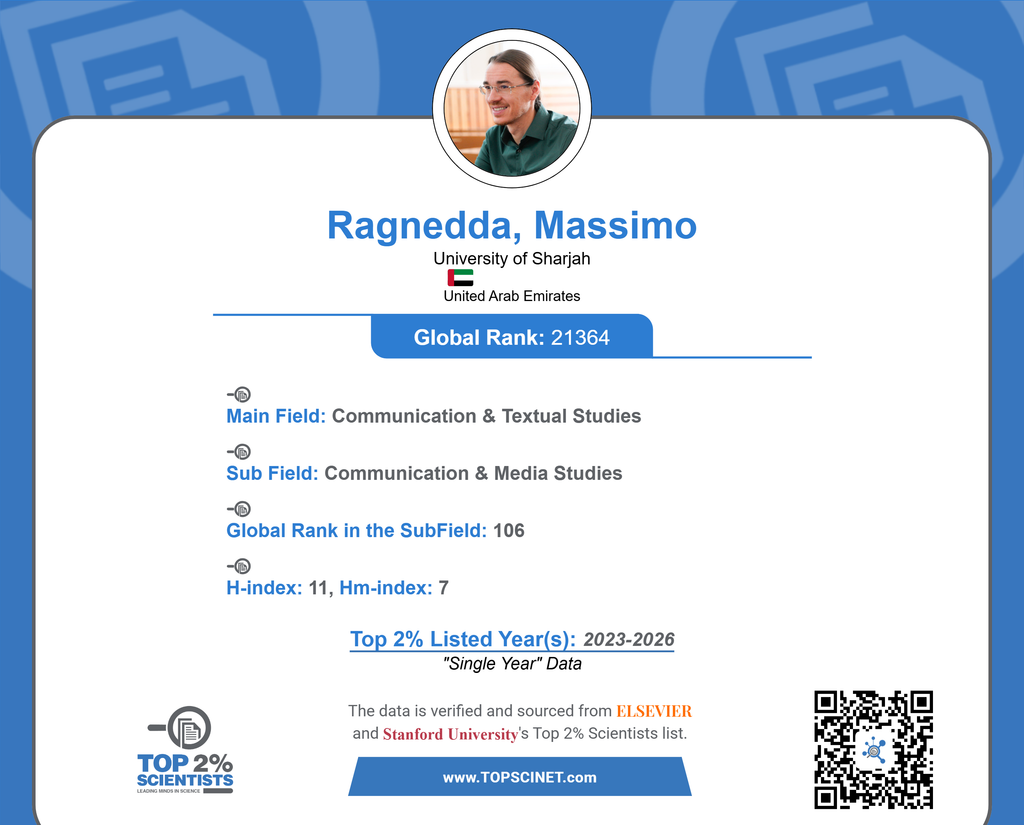
For the fourth consecutive year, I have been included in the Stanford/Elsevier Top 2% Scientists List. This is certainly a welcome recognition, although I would not attach too much importance to any single academic ranking.
The list, developed by a team led by Stanford University’s John Ioannidis and based on data from Scopus, uses a composite set of citation indicators to identify researchers with particularly high citation impact across different scientific fields and subfields. The database distinguishes between career-long impact and more recent research impact.
But what does a citation actually mean?
In simple terms, when an article is cited, another researcher has referred to that work in their own research. The citation may mean that the article provided evidence, a theoretical framework, a method, data, or a starting point for a subsequent study. Citations therefore provide one indication that research has been taken up and used by other researchers.
This is important, but it is not the same as saying that highly cited research is necessarily better research. Citation patterns vary considerably across disciplines, and citation metrics can capture only part of what we mean by research quality and impact. Even Elsevier itself cautions against treating any single metric as a complete measure of research performance.
This matters particularly in fields such as Communication and Media Studies and the wider Social Sciences, where publication and citation practices differ from those of some larger and more citation-intensive scientific fields. For this reason, the Stanford/Elsevier database also provides comparisons within specific fields and subfields rather than relying only on a single global ranking.
In my case, the 2026 list places me at #106 worldwide in Communication & Media Studies, approximately within the top 1% of researchers in the subfield.
I am pleased about this, of course. More than anything, I see it as a small recognition of many years of research, collaboration and, perhaps, a little bit of good timing in working on questions that other researchers have found useful.
Ultimately, however, the most meaningful form of academic impact is not a position in a ranking. It is the extent to which an idea travels: whether someone reads an article, uses it, challenges it, builds on it, or takes the argument somewhere the original author had not anticipated.
The ranking is therefore nice to have. The conversation that research generates is much more interesting.