The Third Digital Divide
A sociological framework for understanding inequalities in digital outcomes
The Third Digital Divide refers to inequalities in the social, economic, political, cultural and personal benefits that individuals are able to obtain from their use of digital technologies.
The concept extends the study of the digital divide beyond the question of who has access to digital technologies and beyond differences in skills and patterns of use. It focuses on a further dimension of inequality: whether and to what extent individuals are able to convert digital access, resources, skills and participation into meaningful social benefits and improved life chances.
The concept was developed in my book The Third Digital Divide: A Weberian Approach to Digital Inequalities, published by Routledge in 2017. Drawing on Max Weber’s theory of social stratification, the book examines how digital inequalities interact with existing forms of social inequality and how social position can shape the opportunities and outcomes associated with digital technologies.
From the Digital Divide to the Third Digital Divide
Research on the digital divide has traditionally focused on whether individuals and groups have access to digital technologies.
This remains important, but access alone does not explain the full structure of digital inequality.
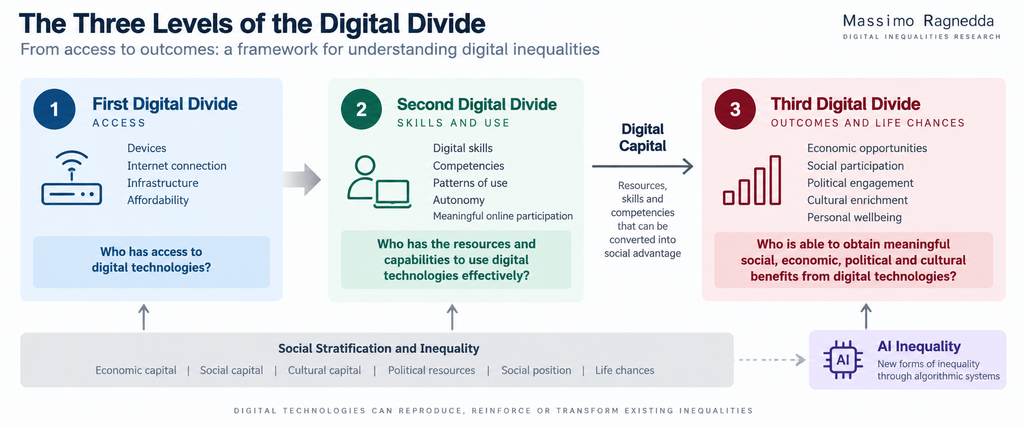
The digital divide can be understood through three interconnected levels:
First Digital Divide — Access
The first level concerns inequalities in access to digital technologies, including devices, Internet connections, infrastructure and connectivity.
The central question is:
Who has access to digital technologies?
Second Digital Divide — Use
The second level concerns inequalities in digital skills, competencies, autonomy, knowledge and patterns of use.
Individuals who have access to the same technologies may nevertheless use them in very different ways and with very different levels of competence.
The central question becomes:
Who has the resources and capabilities to use digital technologies effectively?
Third Digital Divide — Outcomes
The third level concerns inequalities in the benefits and outcomes derived from digital participation.
Two individuals may have comparable access and even comparable digital skills, but still obtain very different benefits from their digital engagement.
The central question therefore becomes:
Who is able to convert digital participation into meaningful social benefits and improved life chances?
This third level connects digital inequality directly to broader processes of social stratification, power and inequality.
What is the Third Digital Divide?
The Third Digital Divide shifts attention from possession and use towards conversion and outcomes.
Access to a device does not automatically produce social advantage. Digital skills do not necessarily translate into economic opportunities. Internet use does not guarantee improved political participation, social connections, cultural resources or personal wellbeing.
The outcomes individuals obtain from digital technologies depend on the interaction between digital resources and their broader social position.
This means that digital inequalities cannot be understood independently from the social structures in which individuals are embedded.
The Third Digital Divide therefore asks not simply whether people use digital technologies, but what they are able to obtain from that use.
Digital Inequality and Social Stratification
A central argument of the Third Digital Divide framework is that digital inequalities are closely connected to existing patterns of social stratification.
Individuals enter digital environments with different levels of:
- economic capital;
- social capital;
- cultural capital;
- political resources;
- personal resources;
- digital skills and competencies;
- access to networks and institutions.
These resources shape how individuals engage with digital technologies and their capacity to transform digital participation into meaningful outcomes.
Digital technologies can therefore reproduce, reinforce and sometimes transform existing inequalities rather than simply eliminating them.
The study of digital inequality consequently requires an analysis of both the digital and the social conditions that shape people’s opportunities.
Digital Capital and the Third Digital Divide
The concept of Digital Capital provides an important bridge between the second and third levels of the digital divide.
Digital Capital refers to the digital resources, competencies and capabilities that individuals accumulate through their engagement with digital technologies.
However, possessing Digital Capital does not automatically guarantee positive outcomes.
Its value depends on its interaction with other forms of capital and with the individual’s broader social position.
The relationship can therefore be represented as:
Social and economic position
↓
Digital access and resources
↓
Digital Capital
↓
Digital practices and participation
↓
Social, economic, political, cultural and personal outcomes
The final stage is where the Third Digital Divide becomes visible.
Research on Digital Capital has subsequently developed this relationship empirically, including work examining the conversion of digital capital into benefits across different areas of life.
A Weberian Approach to Digital Inequalities
The Third Digital Divide is grounded in a sociological understanding of inequality and particularly draws on Max Weber’s theory of social stratification.
From this perspective, inequality is not reducible to economic resources alone.
Status, prestige, political power, social position and access to opportunities can also shape individuals’ life chances.
The digital environment should therefore not be treated as an independent sphere detached from society.
Instead, digital participation is embedded within existing structures of inequality.
The question is consequently not simply whether digital technologies create inequality, but how existing inequalities are reproduced, reinforced or transformed through digital technologies.
This approach places digital inequality within the broader sociology of stratification and life chances.
The Inequality Loop
The relationship between social inequality and digital inequality can produce a cumulative process.
Individuals with greater resources may be better positioned to acquire digital technologies, develop digital competencies and use digital resources strategically.
These digital resources can then generate further social, economic, cultural or political advantages.
Those advantages can subsequently reinforce the individual’s original social position.
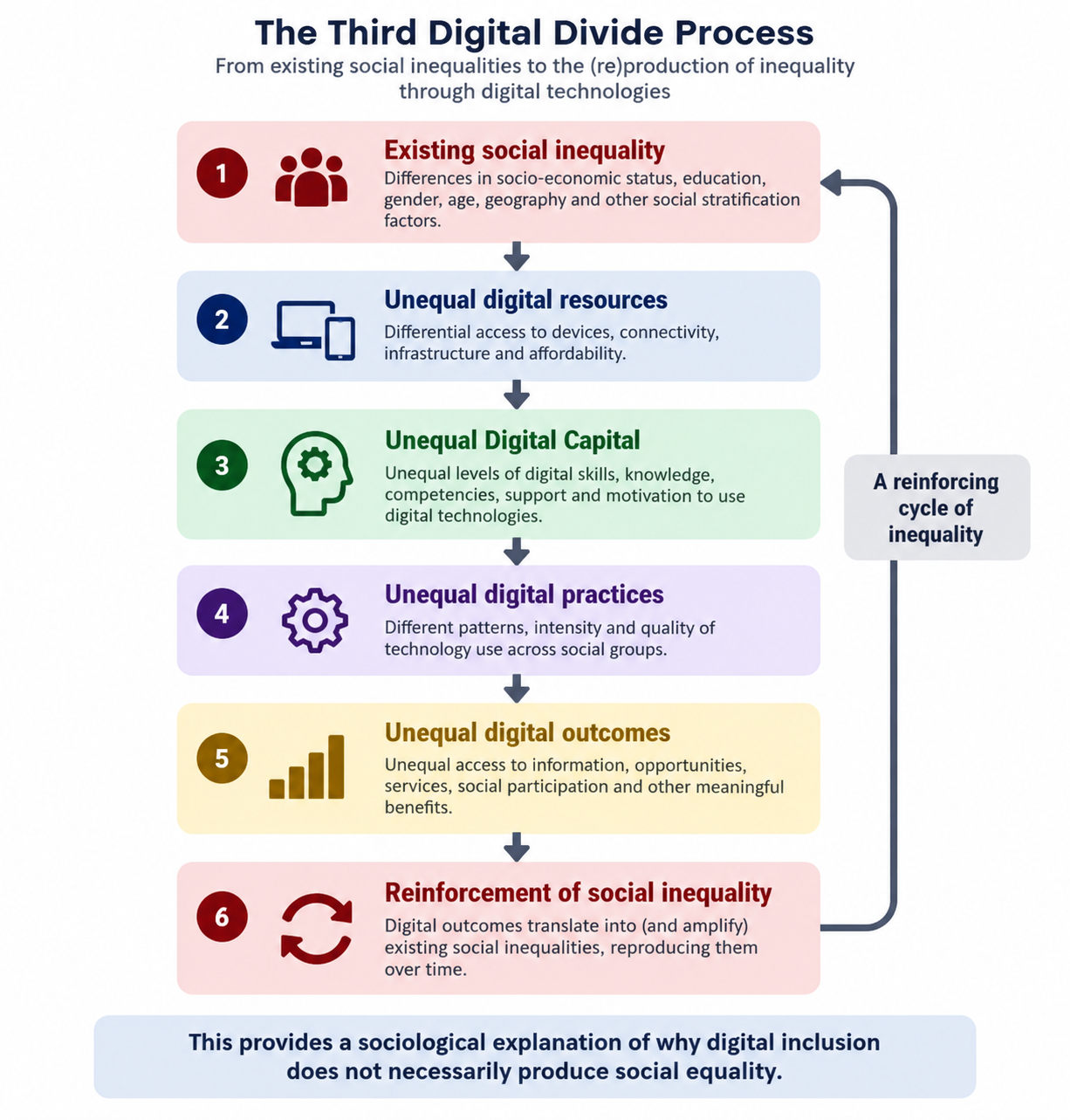
This provides a sociological explanation of why digital inclusion does not necessarily produce social equality.
Research on the Inequality Loop
This framework was developed and empirically examined in research on the self-reinforcing relationship between digital and social exclusion. Using quantitative analysis of a representative sample of UK citizens, the study examined how social and economic vulnerabilities are associated with different levels of digital inclusion.
Ragnedda, M., Ruiu, M. L., & Addeo, F. (2022). The self-reinforcing effect of digital and social exclusion: The inequality loop. Telematics and Informatics, 72, 101852. Read the article →
The Inequality Loop in Conversation
Video — YouTube – The Inequality Loop: Why Being Online Isn’t Enough
Podcast — Digital Inequalities: Conversations on Technology and Society – The Inequality Loop: Why Being Online Isn’t Enough
The Third Digital Divide Today
The development of Artificial Intelligence raises a further question for the study of digital inequality.
If digital technologies already generate unequal outcomes, what happens when increasingly important processes of prediction, classification, recommendation and allocation are mediated by algorithmic systems?
The emergence of AI therefore extends the problem addressed by the Third Digital Divide.
The question is no longer only:
Who benefits from using digital technologies?
It also becomes:
Who is represented, predicted, classified and advantaged or disadvantaged by the systems that increasingly mediate access to opportunities and resources?
My current research develops this question through the concept of the Inequality Regime of AI, examining how Artificial Intelligence can reproduce and transform existing structures of inequality through processes of prediction, power and resource allocation.
Research and Publications
The Third Digital Divide
Ragnedda, M. (2017). The Third Digital Divide: A Weberian Approach to Digital Inequalities. Routledge.
The book develops a sociological interpretation of digital inequality based on Weberian theories of stratification, status and life chances.
DOI: 10.4324/9781315606002
Conceptualizing Digital Capital
Ragnedda, M. (2018). “Conceptualizing Digital Capital.” Telematics and Informatics, 35(8), 2366–2375.
This article develops the concept of Digital Capital and examines its relationship with existing forms of economic, social, cultural, political and personal capital. It explicitly connects Digital Capital with the second and third levels of the digital divide.
DOI: 10.1016/j.tele.2018.10.006
Converting Digital Capital into Benefits
Ragnedda, M., Ruiu, M. L., Addeo, F., & Delli Paoli, A. (2022). “Converting digital capital in five key life realms.” Italian Sociological Review, 12(1), 19–40.
This research examines how Digital Capital can be converted into outcomes across economic, social, cultural, political and personal dimensions.
The Third Digital Divide in Research
The Third Digital Divide has subsequently been used as a framework for examining digital inequalities across different countries, populations and social contexts.
Its central contribution is to shift the analytical focus from digital inclusion as access towards digital inclusion as the capacity to obtain meaningful outcomes.
This perspective is particularly relevant as digital technologies become increasingly embedded in education, employment, healthcare, political participation, social relationships and everyday life.
Related Research
How digital resources and competencies interact with other forms of capital and social position.
Explore Digital Capital → AI Inequality
How algorithmic systems can reproduce and transform inequalities through prediction, classification and allocation.
Explore AI Inequality → Digital Inequalities
Research on the structural, social and global dimensions of digital inequality.
About Massimo Ragnedda
Massimo Ragnedda is a Professor of Media and Communication whose research examines how digital technologies reproduce, reinforce and transform existing social inequalities.
His research focuses particularly on Digital Capital, the Third Digital Divide, digital inequalities and AI inequality.
Read more about Massimo Ragnedda