Why AI inequality is no longer only about digital access, but about who controls data, algorithms, infrastructures and the means of prediction.
Artificial intelligence is reshaping inequality by deciding who is visible, valuable and eligible. This post explains The Inequality Regime of AI, a sociological account of prediction, power, digital divides, techno-colonialism, environmental harm and redistributive AI justice for researchers and policymakers.
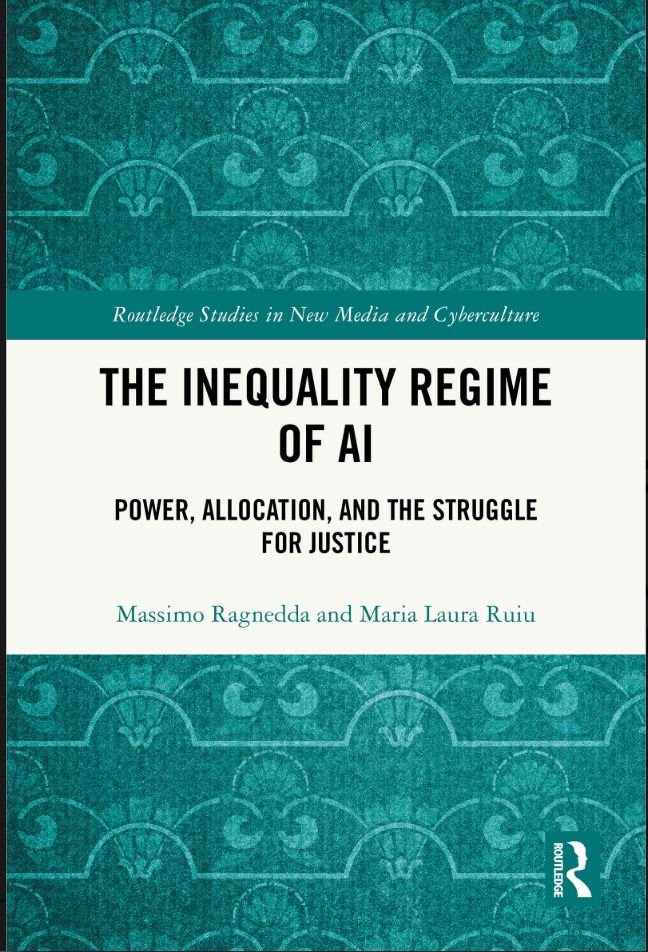
The Inequality Regime of AI. Power, Allocation, and the Struggle for Justice
Artificial intelligence is now involved in decisions about work, welfare, education, finance, policing, health, public services and everyday communication. This matters because AI does not simply automate tasks. It classifies people, predicts behaviour, ranks risk, distributes opportunities and shapes what institutions can see. For this reason, the central question is not only whether AI is accurate, efficient or biased. The more difficult question is: what kind of social order does AI help to build?
In The Inequality Regime of AI: Power, Allocation, and the Struggle for Justice, co-authored with Maria Laura Ruiu, I address this question by developing a sociological account of artificial intelligence as a system of power. The book moves beyond the idea that digital inequality is mainly about access to technologies. Access still matters, of course. But AI introduces a deeper problem: people may be connected, active and datafied, while still having very little power over how they are interpreted, classified or governed.
The book builds on my previous work on digital capital, the third digital divide and digital inequality, but moves the analysis towards predictive and allocative forms of power.
The book’s central argument is that AI is becoming an inequality regime: a durable social formation in which digital technologies, institutions and infrastructures organise the distribution of visibility, value and voice. In this regime, inequality is not only reproduced through income, education or access to devices. It is also produced through data systems, predictive models, platform infrastructures and automated forms of decision-making.
What Is the Inequality Regime of AI?
By “inequality regime of AI”, we refer to a system in which artificial intelligence helps organise social hierarchies through prediction, classification and allocation.
The concept builds on earlier work on inequality regimes, digital divides and digital inequalities, but extends them to the age of AI. In the 1990s, debates on the digital divide focused mainly on who had access to computers and the Internet. Later research showed that access alone was insufficient. Digital skills, literacies, uses and outcomes also mattered. In our previous work on digital inequalities and digital-environmental poverty, we examined how digital resources are connected to broader forms of social, economic and environmental disadvantage.
This book takes the next step. AI shifts the problem from participation to prediction. The key question is no longer only “Who can access digital technologies?” but also “Who is made legible to AI systems, under which assumptions, and with what consequences?”
This is why we describe AI as an inequality regime rather than simply as a technology. AI systems do not merely reflect the social world. They increasingly participate in making it. They define categories, identify risks, recommend actions, automate eligibility and influence which futures become more or less likely.
From Digital Divide to Intelligence Divide
The book argues that we are witnessing a transition from digital divides to what we call an intelligence divide.
A digital divide concerns unequal access to digital technologies, skills and benefits. An intelligence divide concerns unequal control over the systems that produce prediction, classification and automated judgement.
In practical terms, this means that inequality now depends on questions such as:
Who owns the data used to train AI systems?
Who designs the models that classify people?
Who decides what counts as risk, relevance, productivity or normal behaviour?
Who can contest an automated decision?
Who benefits from AI-generated value, and who absorbs the costs?
This shift is important because AI operates through infrastructures that are often difficult to see and harder to challenge. People may not know when an algorithmic system has influenced a hiring decision, a welfare assessment, a loan application, a school placement, a police intervention or a medical prioritisation process. Inequality becomes less visible, not less powerful. The machine wears a lab coat; the politics is still there.
The Allocative Turn: Why AI Is About Distribution
One of the central concepts in the book is the allocative turn.
The allocative turn describes the movement from digital participation to algorithmic allocation. Earlier digital technologies often promised access, voice and participation. AI systems increasingly sort, rank and allocate. They influence who receives attention, credit, services, employment, mobility, security and recognition.
This does not mean that AI always produces unfair outcomes. That would be too simple. The point is more sociological: AI systems are becoming part of the institutional machinery through which life chances are distributed. Once this happens, questions of fairness cannot be reduced to technical bias correction. They require a broader analysis of power, governance and justice.
Three Core Fractures: Data, Algorithms and Governance
The book identifies three fractures at the centre of AI inequality.
The Data Divide
The data divide concerns who is represented in data, how they are represented and under what conditions. Some groups are overexposed to surveillance and risk classification. Others are rendered invisible because their languages, practices, needs or experiences are poorly represented in datasets.
This creates a paradox. Being visible to AI can be harmful when visibility means surveillance, profiling or risk scoring. But being invisible can also be harmful when invisibility means exclusion from services, recognition or resources.
The Algorithmic Divide
The algorithmic divide concerns unequal power over model design, interpretation and deployment. AI systems encode assumptions about what matters, which variables count, which outcomes are desirable and which errors are tolerable.
These are not only technical decisions. They are also political and epistemic decisions. Whoever controls the model often controls the terms through which people and institutions are made understandable.
The Governance Divide
The governance divide concerns who sets the rules. Many AI systems are developed by private companies but used in public or quasi-public contexts. This creates accountability gaps. Citizens may be affected by decisions that neither public institutions nor private actors can fully explain, audit or contest.
The governance divide is therefore not only about regulation. It is about democratic capacity: the ability of societies to decide how intelligence should be designed, used and limited.
The AI Stratification Spiral
Another key concept in the book is the AI stratification spiral.
The AI stratification spiral describes how inequalities can become recursive. Unequal data produces biased classifications. Biased classifications shape institutional decisions. These decisions generate new data, which then appears to confirm the original classification.
For example, if a predictive system identifies a community as risky, that community may be subjected to more monitoring. More monitoring produces more recorded incidents. These incidents then reinforce the system’s original risk classification. The result is not simply bias. It is cumulative stratification.
This matters because AI systems can transform historical inequality into statistical common sense. Past injustice becomes future prediction. The past does not repeat itself; it gets a software update.
Algorithmic Habitus: How AI Shapes the Self
The book also introduces the concept of algorithmic habitus.
Algorithmic habitus refers to the ways in which people adjust their behaviour in response to algorithmic systems. When people know, or suspect, that they are being scored, ranked, recommended or filtered, they may begin to act in ways that make them more legible and less risky.
This is visible in many areas of life: jobseekers adapting CVs to applicant tracking systems; content creators producing for platform metrics; students responding to learning analytics; workers managing performance dashboards; citizens navigating automated welfare systems.
The key point is that AI does not only classify subjects from outside. It can also shape how people present themselves, discipline themselves and imagine what is possible.
Bias Is Not Just a Technical Error
The book engages with the literature on algorithmic bias, but it also argues that bias cannot be treated only as a correctable technical defect.
Bias matters. However, if bias is framed only as a problem of inaccurate data or flawed design, the analysis remains too narrow. AI systems often operate within institutions that are already unequal. A fairer model inserted into an unfair institutional structure may still reproduce injustice.
This is why the book discusses bias as structural, symbolic and algorithmic violence. Structural violence refers to institutional arrangements that systematically disadvantage some groups. Symbolic violence refers to forms of classification that make domination appear natural or deserved. Algorithmic violence emerges when computational systems intensify these processes while presenting them as neutral or objective.
AI, Labour and Institutional Inequality
AI inequality is not confined to spectacular cases of algorithmic failure. It is also embedded in ordinary institutional processes.
In labour markets, AI can automate recruitment, monitor productivity and reorganise work. In welfare systems, it can classify eligibility, suspicion or compliance. In education, it can shape assessment, access, tracking and student profiling.
The point is not that every use of AI in these sectors is harmful. The more careful claim is that AI changes how institutions see people. It can make institutions faster, but not necessarily more just. It can expand administrative capacity while reducing interpretive responsibility. It can generate decisions at scale while making contestation more difficult.
AI and Environmental Inequalities
One of the book’s contributions is to connect AI inequality to environmental inequality.
AI is often discussed as if it were immaterial: data, clouds, models, platforms. Yet AI depends on energy, water, minerals, land, logistics, data centres, devices and labour. Its environmental costs are not evenly distributed. Communities far from the centres of AI development may bear the burdens of extraction, pollution, e-waste and infrastructural expansion.
This argument builds on my work on digital-environmental poverty, where digital inequality and environmental disadvantage are examined together. In the book, we extend this perspective to AI by arguing that artificial intelligence is part of a broader ecological regime. The question is not only whether AI can help address climate change. It is also whether AI systems themselves deepen ecological asymmetries.
This is especially important because many discussions of “green AI” focus on efficiency. Efficiency is necessary, but not sufficient. A more sustainable AI politics must ask who benefits from computation, who pays its environmental costs and whether all forms of AI expansion are socially necessary.
Techno-Colonialism and Epistemic Extractivism
The book also develops the concept of techno-colonialism.
Techno-colonialism refers to the extension of colonial relations through digital and computational systems. AI can extract data, labour and knowledge from populations that have limited power over how these resources are used. It can also universalise dominant assumptions about language, intelligence, rationality and value.
This is not colonialism in the old administrative sense. It is a computational form of power. It works through datasets, platforms, standards, model architectures, labour chains and infrastructures. It is often presented as innovation, but it can reproduce older hierarchies between centre and periphery, North and South, visible and invisible populations.
The concept of epistemic extractivism is central here. It refers to the extraction or marginalisation of knowledge systems. When AI models are trained mainly on dominant languages, dominant institutions and dominant cultural assumptions, other ways of knowing become less visible. The result is not simply technical underrepresentation. It is a narrowing of what counts as intelligence.
Digital Feudalism and the Algorithmic Commons
The book also examines digital feudalism: a condition in which a small number of powerful actors control platforms, models, cloud infrastructures and data flows.
The analogy is not perfect, and it should not be used carelessly. We are not claiming that contemporary capitalism has simply disappeared. Rather, we use the concept to capture the growing importance of rent, enclosure and infrastructural dependency. Many organisations, including public institutions, increasingly rely on systems they do not own, cannot fully inspect and cannot easily leave.
Against this tendency, the book argues for the algorithmic commons: shared, accountable and publicly oriented infrastructures for data, models and computational resources. The algorithmic commons does not mean that all AI should be open without limits. It means that intelligence should not be enclosed entirely within private systems whose priorities are opaque to the publics they affect.
What Makes This Book Different?
The book differs from existing work in four main ways.
First, it connects digital inequality research with AI studies. Rather than treating AI as a separate technological phase, it shows how AI intensifies and reorganises inequalities already present in the digital society.
Second, it moves from bias to regime. Bias remains important, but the book asks how institutions, infrastructures and political economies make inequality durable.
Third, it analyses AI across multiple scales: the self, institutions, global infrastructures, ecological systems and democratic futures.
Fourth, it links social justice, environmental justice and epistemic justice. AI inequality is not only about unfair decisions. It is about who can be known, who can decide, whose knowledge counts and whose environments are sacrificed.
Who Should Read the Book?
The book is written for researchers, PhD students and advanced students working on digital society, AI ethics, media studies, sociology, political economy, governance, data justice, platform studies and technology policy.
It may also be useful for journalists and policymakers who want to move beyond simplified debates about whether AI is good or bad. The more important question is how AI is organised, owned, governed and contested.
Professionals working in technology, education, welfare, labour policy, public administration and sustainability may also find the book useful because it provides a vocabulary for identifying forms of inequality that are often hidden inside technical systems.
Future Research and Practical Implications
The book closes by arguing that critique is not enough. If AI is becoming part of the infrastructure of social life, then democratic societies need more than ethical principles. They need redistributive infrastructures, stronger public capacities, participatory governance and forms of AI literacy that are not reduced to individual skills.
Future research should examine how AI inequalities operate in specific contexts: welfare systems, schools, workplaces, health services, migration regimes, climate governance and platform economies. It should also examine how people resist, reinterpret or refuse algorithmic classification. Not all users are passive subjects of AI systems. Many develop everyday tactics of negotiation, opacity, critique and collective action.
The practical implication is clear: AI justice cannot be achieved only by improving models. It requires changing the social conditions in which models are built and used. This includes public oversight, data rights, environmental accountability, labour protections, epistemic plurality and democratic control over high-impact systems.
The question, therefore, is not whether AI will shape the future. It already does. The question is whether intelligence will remain concentrated as a private and predictive form of power, or whether it can be reorganised as a collective resource.
About the Book
The Inequality Regime of AI: Power, Allocation, and the Struggle for Justice is co-authored by Massimo Ragnedda and Maria Laura Ruiu and published by Routledge in the series Routledge Studies in New Media and Cyberculture. The book is organised into four parts: from digital divides to inequality regimes; architectures of allocation; global orders of extraction; and horizons of justice. Its chapters address the AI stratification spiral, the allocative turn, algorithmic habitus, institutional inequality, structural and algorithmic violence, environmental inequalities, techno-colonialism, digital feudalism, algorithmic commons, literacies of liberation and redistributive infrastructures.
Continue the Conversation
I wrote this book to contribute to a broader debate about AI, inequality and justice. I would be very interested to hear from researchers, students, journalists, policymakers and practitioners working on related questions. What forms of AI inequality are you seeing in your field? Which concepts help explain them, and which remain insufficient?
The book is available from Routledge here
FAQ
1. What is the inequality regime of AI?
It is a social formation in which AI systems organise inequality through data, prediction, classification, governance and allocation.
2. How does AI change digital inequality?
AI shifts inequality from access and participation towards prediction, legibility and control over automated decision-making systems.
3. What is the allocative turn?
The allocative turn describes how AI systems increasingly distribute opportunities, risks and resources through automated classification.
4. What is the AI stratification spiral?
It is a recursive process in which unequal data produces biased classifications, which shape institutions and generate further unequal data.
5. What is algorithmic habitus?
Algorithmic habitus refers to how people adapt their behaviour to become more visible, eligible or low-risk within algorithmic systems.
6. Why is AI bias not only a technical problem?
Because AI systems often operate within unequal institutions, correcting data or models alone may not address structural injustice.
7. What is techno-colonialism?
Techno-colonialism describes how AI can reproduce colonial relations through data extraction, labour exploitation and epistemic domination.
8. How is AI connected to environmental inequality?
AI depends on energy, minerals, water, data centres and labour, with environmental costs often displaced onto marginalised regions.
9. What are redistributive AI infrastructures?
They are public, accountable and shared systems that redistribute access to data, computational resources, expertise and decision-making power.
10. Who should read this book?
Researchers, PhD students, journalists, policymakers and professionals interested in AI, digital society, inequality, governance and justice.