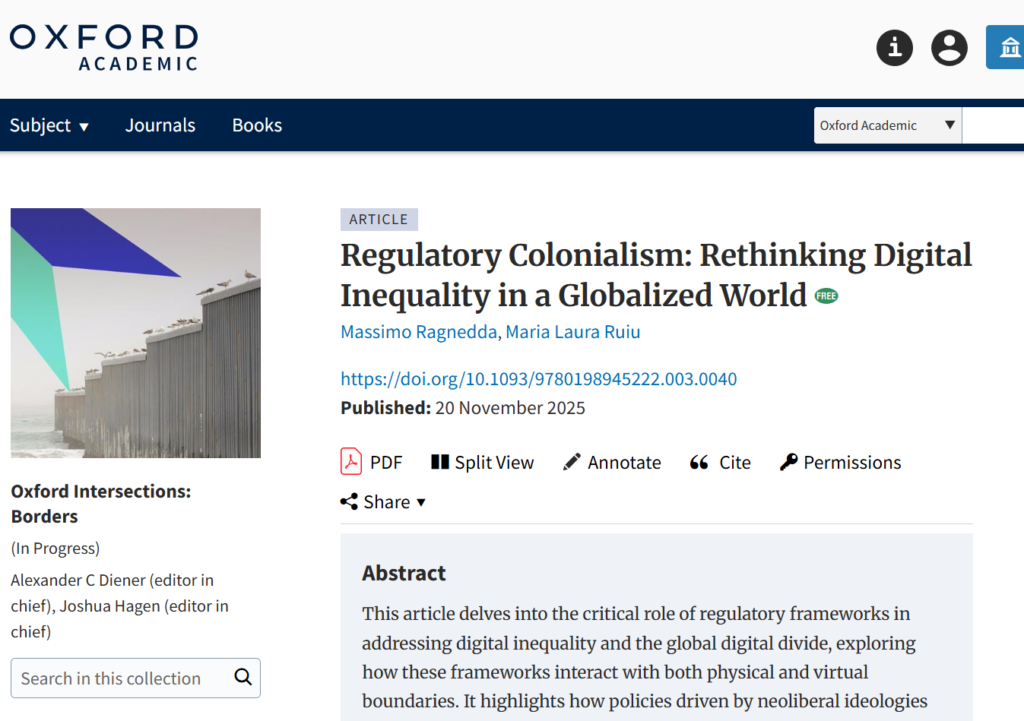
Our new article is out today in the Oxford Intersections series.
Regulatory Colonialism: Rethinking Digital Inequality in a Globalized World, written by Maria Laura Ruiu and myself, asks a simple question:
What if the most powerful borders today aren’t on maps, but in data centres, cloud contracts, and lines of code?
In the article, we argue that the global digital divide is not an unfortunate gap. It is a political architecture, built, maintained, and protected by those who benefit from it.
A few points emerge clearly:
Digital colonialism is no longer a metaphor: when corporations in the Global North own the cloud, the undersea cables, the data centres, and the governance standards, “connectivity” becomes dependency. India’s cloud market illustrates this perfectly: more than 60% controlled by U.S. providers.
Control the infrastructure, control the sovereignty.
Regulation draws borders too. GDPR is praised globally, yet it exports Northern priorities to countries that never helped shape it. Compliance becomes the entry ticket to the digital economy, often at the cost of autonomy.
AI is the new frontier of exclusion. Thin, biased, or missing data can lock people out of visibility, credit, mobility, or opportunity. This is not just a divide, it is a sorting mechanism.
Neoliberal reforms deepen the dependency trap. Years of privatisation and externally driven “modernisation” have pushed many developing nations to rely on foreign infrastructures, weakening local capacity and reinforcing global asymmetries.
The Global South is invited to “join the digital future”, but on terms set elsewhere. Still, there are openings:
– Decentralised infrastructures, community networks, and digital cooperativism show that alternatives already exist.
– Regional strategies, from the African Union to ASEAN, demonstrate how collective bargaining can shift structural imbalances.
– True inclusion depends on ownership, governance, and agency, not just access.
The article closes with a difficult but essential argument:
The global digital divide persists because it is profitable.
Closing it demands dismantling the political economy that keeps it open.
If we want genuine digital equality, we must stop treating it as a development issue and start treating it as what it is:
a struggle over power, borders, and the right to shape one’s digital destiny.
📘 Read our chapter (open access):
https://academic.oup.com/edited-volume/61655/chapter/540204858
🎧 Listen to the podcast on Spotify:
https://open.spotify.com/episode/5hPUzXiilKvwDy57w3LXGG?si=ZYFKPRjAQ8–i6hQ8yJfwQ
🎥 Watch the video summary on YouTube:
https://www.youtube.com/watch?v=NC3SWqZfWe8&t=9s
Lascia un commento